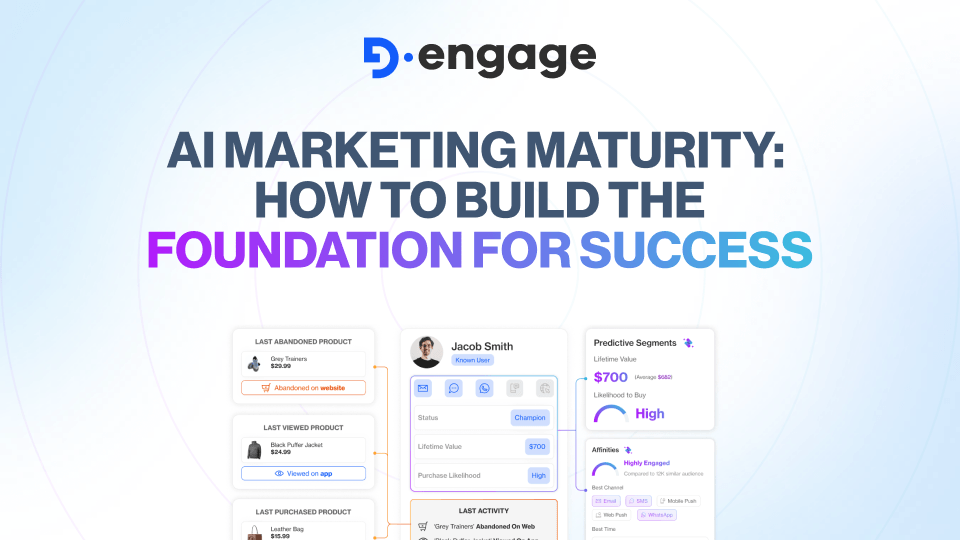
The ONLY marketing automation platform with a composable CDP
Composable CDP Explained
Your data warehouse is your most powerful marketing asset, you just need to activate it.
Your customer data already exists in your warehouse. It’s clean, governed, and trusted by your data team. So why does your Customer Data Platform (CDP) tell a different story?
For most marketing teams, there’s a gap between what your data warehouse knows and what your tools can act on. This shows up in campaigns that miss the mark, attribution that doesn’t hold up to scrutiny, and constant questions about which numbers are accurate.
A composable CDP is the architecture designed to close that gap. It connects your marketing tools directly to your warehouse without duplicating, migrating, or compromising your data in the process.
This guide explains what a composable CDP is, how it works, and why more marketing teams are moving to warehouse-native approach. You’ll see how it changes segmentation, personalization, and campaign execution, with examples from retail and financial services.
By the end, you should have a clear view of why a composable CDP is the best approach for your current setup.
Traditional CDPs work like a set menu at a restaurant. You get what the chef decides, in the order they choose. A composable CDP is like an open kitchen full of your own ingredients, and the tools to help you cook whatever your customers want.
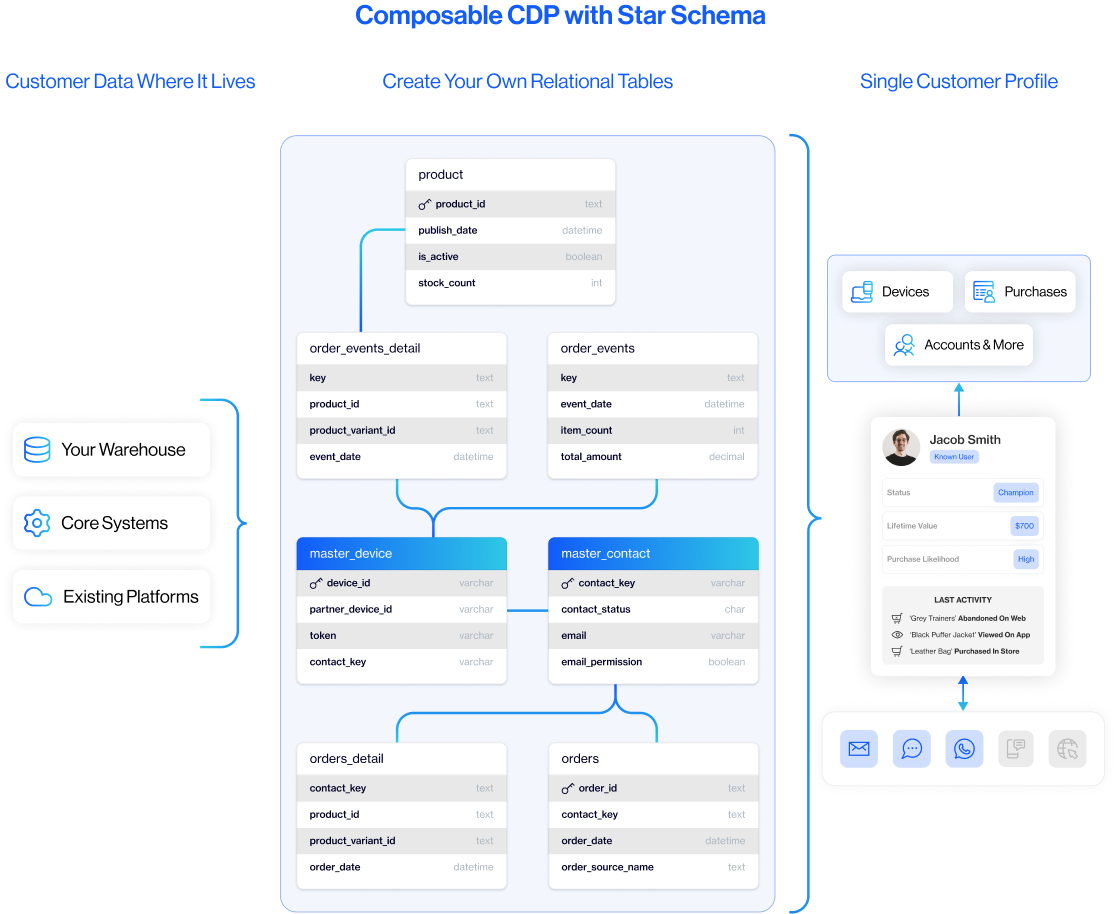
A composable CDP uses your existing data warehouse as the foundation for customer data, with a separate activation layer that connects directly to it.
Instead of copying customer data into a vendor-controlled platform, your data stays in your own environment (such as Redshift, BigQuery, PostgreSQL, and other supported data platforms). A composable CDP like D·engage sits on top, enabling segmentation, identity resolution, and omnichannel activation without moving or duplicating the data.
This approach changes how marketing teams work with data because every segment is built from the same tables your analytics team uses. Every campaign is based on the same definitions that power reporting. There is no need to reconcile numbers between systems because there is only one source of truth.
Composable is also modular. You’re not locked into a single platform that dictates how your data should be structured or used so your data model remains your own, shaped around your business: not a vendor’s schema. You can adopt only the components you need and evolve them over time.
In practical terms, this leads to much faster time to value. Instead of long data migration projects, teams can connect to existing warehouse tables and begin building audiences in a matter of days. Historical data is immediately available, without archiving limits or additional storage costs inside a separate platform.
Packaged CDPs were built to solve a real problem. They made customer data accessible to marketers without requiring deep technical support. They provided interfaces for segmentation, pre-built connectors, and managed infrastructure that removed the need for a data engineering team.
For many organisations, that was a necessary first step. But the architecture is limiting because a packaged CDP needs data to be copied into its own environment before it can be used.
That creates a second version of your customer data, separate from what exists in your warehouse. Over time, those two customer profiles drift apart and the numbers in your CDP no longer match your internal reporting. Teams have to spend time explaining discrepancies instead of acting on insight.
Composable CDP removes that duplication by working directly on top of your warehouse, so every team is using the same underlying data.
Going back to the restaurant analogy, it’s the difference between taking your ingredients to another space where you might forget or misplace items during transit, and cooking in your own kitchen which already has everything you need.
Here’s how the two approaches compare in practice:
| Packaged CDP | Composable CDP | |
|---|---|---|
| Data location | Data is copied into vendor environment | Data remains in your warehouse |
| Real-time capability | Real-time for in-platform events only | Real-time for any warehouse-driven data |
| Data ownership | Vendor-controlled schema and storage | Full control of your data model |
| Time to value | Months of integration and mapping | Days to connect existing tables |
| Source of truth | Separate from BI and analytics | Shared across all teams |
| Data consistency | Prone to drift between systems | Aligned by design |
| Flexibility | Limited by vendor schema | Adapts to your business model |
Packaged CDPs still have strengths. They offer user-friendly interfaces, pre-configured templates, and real-time capabilities for events generated within their own platforms. For teams without a mature data setup, they can provide a faster starting point.
The trade-off becomes clear as the business grows. As more data sources are added and use cases become more complex, the cost of duplication increases:
A composable CDP, on the other hand, assumes your data warehouse is already the centre of gravity for your business. Instead of creating another system alongside it, D·engage connects directly to that foundation and extends it into marketing activation
For marketing leads, the value of a composable CDP shows up quickly in campaign performance and operational efficiency. For senior stakeholders, the impact is broader. It affects how the business manages data, controls cost, and reduces long-term risk.
Here are seven reasons why composable CDPs are valuable across the board:
Instead of only serving marketing teams, the same data foundation supports business intelligence reporting, data science models, customer experience tooling, and paid media activation. Teams work from the same definitions and the same underlying data, reducing internal friction and improving decision-making.
Packaged CDPs require your customer data model, identity rules, and activation logic to be built inside their environment. Moving away becomes difficult and expensive. With a composable setup, those foundations remain in your warehouse. You can change activation tools without rebuilding your data layer.
Packaged platforms typically charge based on customer records or data volume so, as your data grows, so does your bill. This can limit how much historical or behavioral data you bring into the platform. A composable model can reduce this constraint by letting data live in the warehouse, where storage typically scales more predictably, while activation costs are tied more closely to usage. Your warehouse scales predictably, and activation costs are tied to usage rather than data richness.
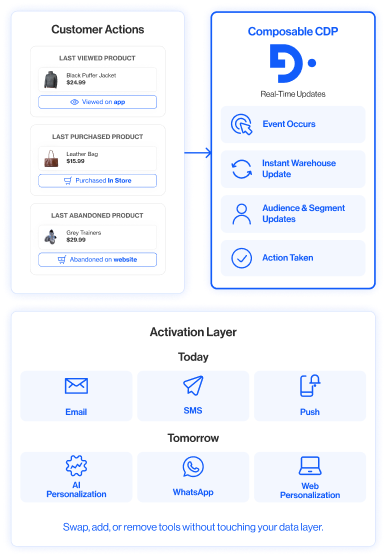
Packaged CDPs often operate in real time for events they collect directly, but rely on batch processes for data coming from other systems. This creates delays between a customer action and your ability to respond. Composable architecture reduces that gap by working directly from warehouse updates, allowing campaigns and segments to reflect changes as they happen.
As new tools emerge – whether for AI-driven personalization or new channels – a composable setup allows you to adopt them without restructuring your data. Your warehouse remains stable while the activation layer evolves around it.
Keeping customer data inside your own environment reduces the risk of exposure and simplifies compliance. There’s no need to duplicate sensitive data into third-party systems, which makes governance easier to manage.
Because activation happens directly on top of the warehouse, marketing teams can work with existing data without waiting for IT teams to update, restructure, or sync information. This also benefits IT teams as they’re no longer tied up managing ongoing data requests and can focus on higher-value work instead.
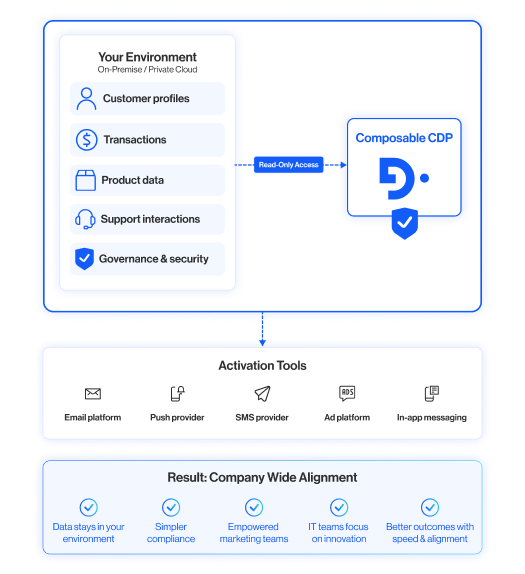
A composable CDP keeps control of data, cost, and future direction within the business, while still giving marketing teams the tools they need to execute quickly and effectively.
Most marketing teams don’t think in terms of data architecture. They think in terms of segments, journeys, and campaign performance. But the structure behind your data determines how well all of those things work.
When your CDP sits on top of a separate copy of your data, every segment is limited by what has been synced into that environment. If a data point isn’t available, or hasn’t been updated yet, it can’t be used. That affects targeting accuracy, timing, and ultimately campaign results.
This is where a composable CDP benefits marketers.
Segmentation happens directly in your warehouse so marketing teams can use any and all data the business has collected. Purchase history, product usage, support interactions, and predictive scores can all be included without additional ingestion or transformation work inside a separate platform.
When marketing and analytics work from different systems, discrepancies are common. A segment count doesn’t match a dashboard, a campaign performs differently than expected, and time is spent investigating the data instead of improving the outcome.
With a warehouse-native approach, those inconsistencies disappear. When segments are built on the same data that powers reporting, there’s no need to reconcile numbers across teams.
Many businesses operate with complex relationships, such as household accounts or multi-product customers. Packaged CDPs often flatten this into a simplified structure, which removes important context. A composable setup works with the data as it exists, preserving those relationships and making segmentation more precise.
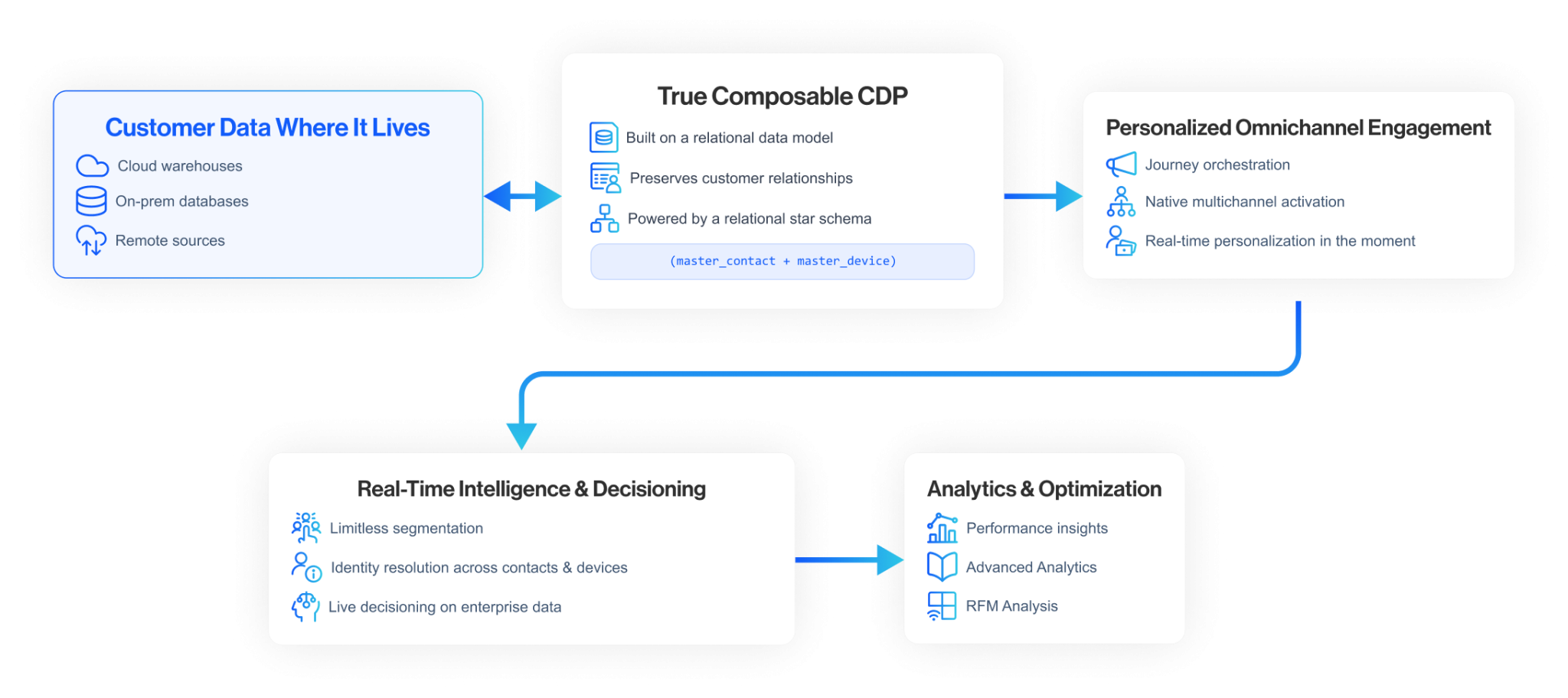
Instead of working within storage limits or retention policies set by a vendor, marketing teams can access years of customer behavior directly from the warehouse. This makes it easier to build long-term lifecycle strategies and more accurate data models.
By using warehoused data your segments are more accurate, timing is more relevant, and personalization reflects the full customer relationship. The result is more effective campaigns. Another win is that marketing teams can focus on execution, rather than working around the limitations of their tools.
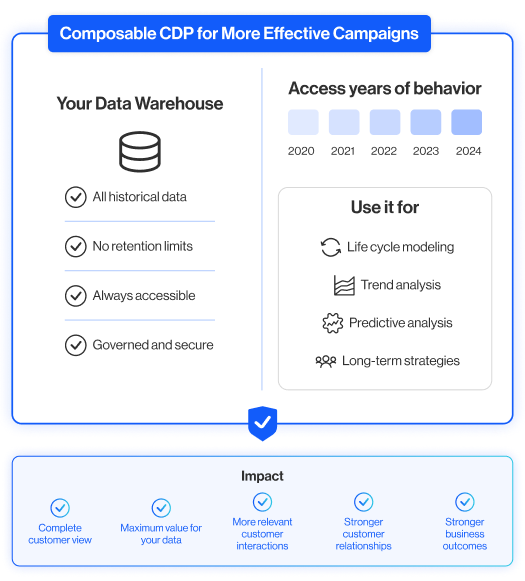
In a packaged CDP, customer profiles are built from the data that has been copied into the platform. That usually excludes part of the picture. Offline transactions, support interactions, backend events, and consent data are often delayed, simplified, or missing entirely.
The result is a profile that looks unified on the surface but does not reflect the full customer relationship. With a composable CDP, you get a bigger picture.
All systems already contribute their data to the warehouse: CRM records, eCommerce activity, product usage, support tickets, and consent signals. With a composable CDP, identity resolution happens against this full dataset: producing a profile that is consistent across the business.
When identity is resolved in the warehouse, marketing, analytics, and customer support are aligned by default. There’s no separate identity graph hidden inside a vendor platform, and no need to reconcile conflicting profiles.
Identity rules are visible and adaptable. If the business needs to change how customers are grouped (for example linking accounts at a household level or separating business and personal usage), those rules can be updated directly in the warehouse without relying on a vendor’s internal logic or release cycle.
With a packaged CDP, identity resolution is typically a black box. You can’t easily inspect how profiles are stitched together, and you can’t take that identity graph with you if you change platforms. Over time, this creates risk. The more your segmentation and campaigns depend on that internal logic, the harder it becomes to move away.
The customer profile is built where your data already lives, and it remains under your control. Activation tools like D·engage simply read from that profile and act on it, ensuring that every campaign reflects the same complete view of the customer.
Real-time is often positioned as the advantage of packaged CDPs. They can react instantly to events happening inside their own platform, such as a page view or app action. For certain use cases, that speed is useful however, most “real-time” only applies to a fraction of your data
Most meaningful customer signals do not originate inside the CDP. They come from your backend systems, your warehouse, and your wider data ecosystem.
Subscription changes, offline purchases, support interactions, and product usage all sit outside the platform. In a packaged setup, those signals are usually processed in batches, which introduces delay.
While real-time is often positioned as the advantage, a composable CDP changes how real-time works.
Instead of relying on periodic syncs, activation is driven directly from the warehouse. As new data arrives or updates, segments and triggers reflect those changes without waiting for a separate ingestion cycle. This reduces the gap between customer behavior and marketing response.
Real-time personalization in a composable setup can take into account the full customer profile at the very moment of activation. A message can reflect recent behavior, long-term purchase history, predicted churn risk, and current account status – all at the same time. Rather than reacting to a single event in isolation, you can implement more relevant interactions.
With a composable CDP, a single audience definition can trigger actions across email, SMS, push, in-app messaging, and paid media without needing to be recreated in different tools.
Packaged CDPs struggle to maintain that consistency when data comes from multiple sources. Real-time capabilities are strongest for in-platform events, but less reliable when external systems are involved. This creates gaps where customers may receive outdated or misaligned messages.
For marketing teams, taking a composable approach means faster response times, more relevant personalization, and fewer cases where campaigns fall out of sync with customer behavior.
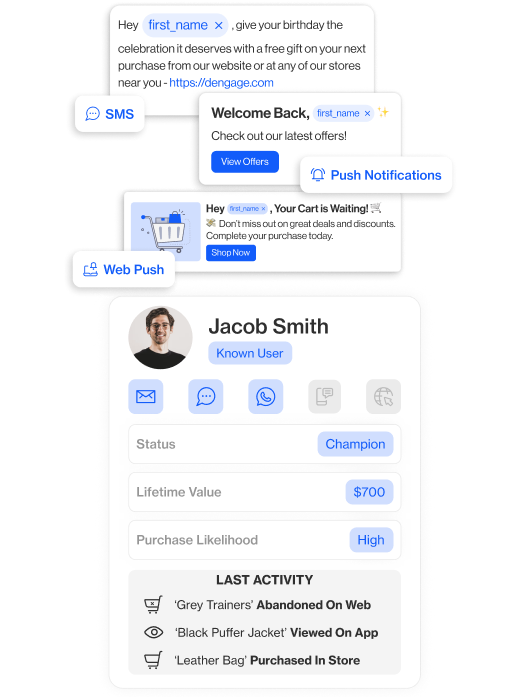
The value of a composable CDP becomes clearer when you see how it works in practice.
In many cases, that “wow” moment happens during a live walkthrough. Seeing D·engage operate directly on warehouse data can change how marketing teams think about segmentation, activation, and what their existing data can actually support.
If you want to explore this with your own setup, you can book a demo to see how D·engage activates your warehouse data in practice.
Across industries, the challenge is often the same. Customer data exists, but consistent data activation – without duplication or delay – is difficult across teams. Composable architecture changes that by connecting activation directly to the cloud and on-prem data warehouse.
The following examples show how this works in two different environments, each with their own constraints and requirements.
For retail and eCommerce teams, customer data is already rich. The challenge is making it usable across the business without rebuilding it in multiple tools.
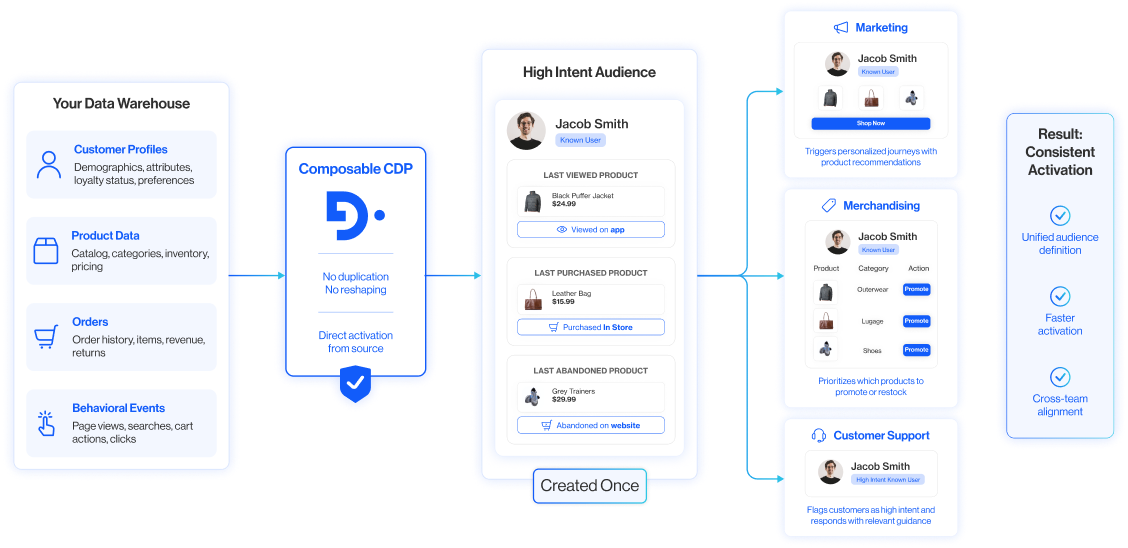
A typical setup includes customer profiles, product data, orders, and behavioral events stored in a data warehouse. Marketing, merchandising, and customer experience teams all need to act on that data (often in different ways).
With a composable CDP, that data is activated directly. Marketing teams can build audience segments using existing tables and real-time signals without duplicating or reshaping the data into a separate system.
For example, a “high intent” audience might include customers who have viewed a category multiple times, added items to their cart, and not completed a purchase within a defined timeframe.
That audience can be created once with With D·engage and reused across teams:
The key difference is consistency. Instead of multiple versions of the same audience built across different tools, the composable approach creates a shared definition that every team can act on.
In financial services, the challenge is different. Data is highly sensitive, heavily regulated, and often spread across multiple systems with complex relationships.
Customer profiles, transactions, product usage, and support interactions are typically stored in a governed warehouse or on-premise environment. Moving that data into a third-party platform introduces both risk and operational overhead.
A composable CDP avoids that duplication.
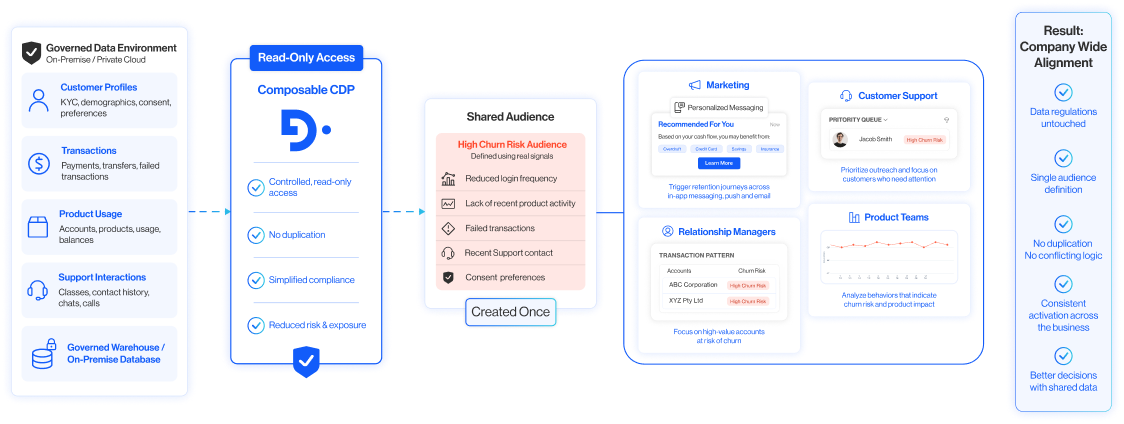
D·engage’s Remote Data Source module provides controlled, read-only access. This allows segmentation and activation to run directly on governed data without ETL or replication. As data remains in its governed environment, this simplifies compliance and reduces exposure.
This approach is well suited to relational data. Customer relationships often span accounts, products, and interactions over time. Instead of flattening that structure into a rigid schema, a composable setup works with the data as it exists.
For example, a shared “high churn risk” audience can be defined using signals such as reduced login frequency, lack of recent product activity, failed transactions, and recent support contact, combined with consent and contact preferences.
That audience segment can then be used across multiple functions:
The value comes from alignment, with the same audience definition used across the business without duplication or conflicting logic between systems
Your data warehouse already contains the most complete view of your customer. The problem is that most marketing teams can’t act on it, because packaged CDPs ask you to move your data before you can use it. You’re working from a copy rather than from the source.
Composable CDPs remove this gap by working directly on top of your own existing data. It’s the difference between working in someone else’s kitchen, and working in your own.
By connecting marketing directly to the source of truth, segments reflect real behavior, personalization is based on full context, and campaigns stay aligned with the rest of the business.
If your current setup creates delays, mismatched numbers, or incomplete customer views, the issue is in the architecture. It’s time to try a composable CDP.
Book a walkthrough and see how D·engage activates your warehouse data directly.
See how leading brands use our platform to enhance performance, improve customer experiences, and achieve measurable business outcomes.
“We boosted our efficiency with D•engage through automation, real-time data sync, and AI-driven targeting, achieving 83% higher account funding and 60% improved operations. All this in just the first year of its integration - This is truly phenomenal”
Monis Usman, EVP Head of Digital Business & Marketing

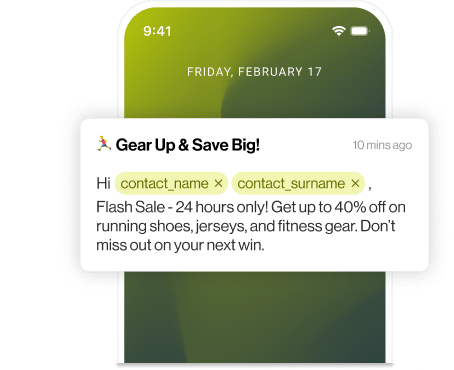
“D·engage’s platform perfectly aligned with Sportive’s business needs. The platform demonstrated superior performance in integrating customer data, generating personalized content, and automation capabilities”
Anıl Can Öztürk, Digital Commerce Director
“Since we started working with D•engage, we’ve gained significant operational efficiency in segmentation, campaign management, and omnichannel communication. We can design personalized campaigns end-to-end through the panel and easily measure content performance with A/B testing.”
Gürhan Öztürk, Communication and Platform Manager

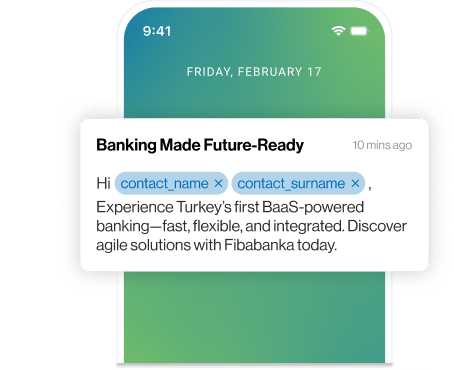
“Sending SMS and email messages without any disruptions is very important in banking processes. Any interruptions can affect our entire sales process. Therefore, the 24/7, high-availability of the platform we use is extremely critical for us.”
Korhan Kocabıyık, Platforms Development Director
Bring all your data, channels, and customers together in one connected platform that works as fast as you do.