The ONLY marketing automation platform with a composable CDP
Comparing Packaged vs. Composable CDPs
a Marketer’s Guide
For years, the Customer Data Platform (CDP) was sold as the "magic pill" for marketing personalization. The promise was simple: plug it in, and suddenly you’d have a 360-degree view of every customer.
But many marketing teams are finding that their "magic pill" has turned into a data silo. They are trapped in a cycle of manual data mapping, skyrocketing storage costs, and - worst of all - discrepancies between what the CDP says and what the company’s actual Source of Truth reports.
The industry has reached a fork in the road:
| Capability | Packaged CDP (Legacy) | Composable CDP (Modern) |
|---|---|---|
| Data Location | Data is copied into vendor environment | Data remains in your warehouse |
| Real-time Capability | Real-time for in-platform events only | Real-time for any warehouse-driven data |
| Data Ownership | Vendor-controlled schema and storage | Full control of your data model |
| Time to Value | Months of integration and mapping | Days to connect existing tables |
| Source of Truth | Separate from BI and analytics | Shared across all teams |
| Data Consistency | Prone to drift between systems | Aligned by design |
| Flexibility | Limited by vendor schema | Adapts to your business model |
In the battle between Packaged and Composable CDPs, the difference is strategic. While packaged platforms ask you to adapt your business to their architecture, a composable approach flips that equation: molding itself around the data infrastructure you’ve already built.
This means marketers gain direct control over their data, faster time to activation, and the freedom to scale without compromise. Here are seven areas where that shift creates a real, measurable advantage.
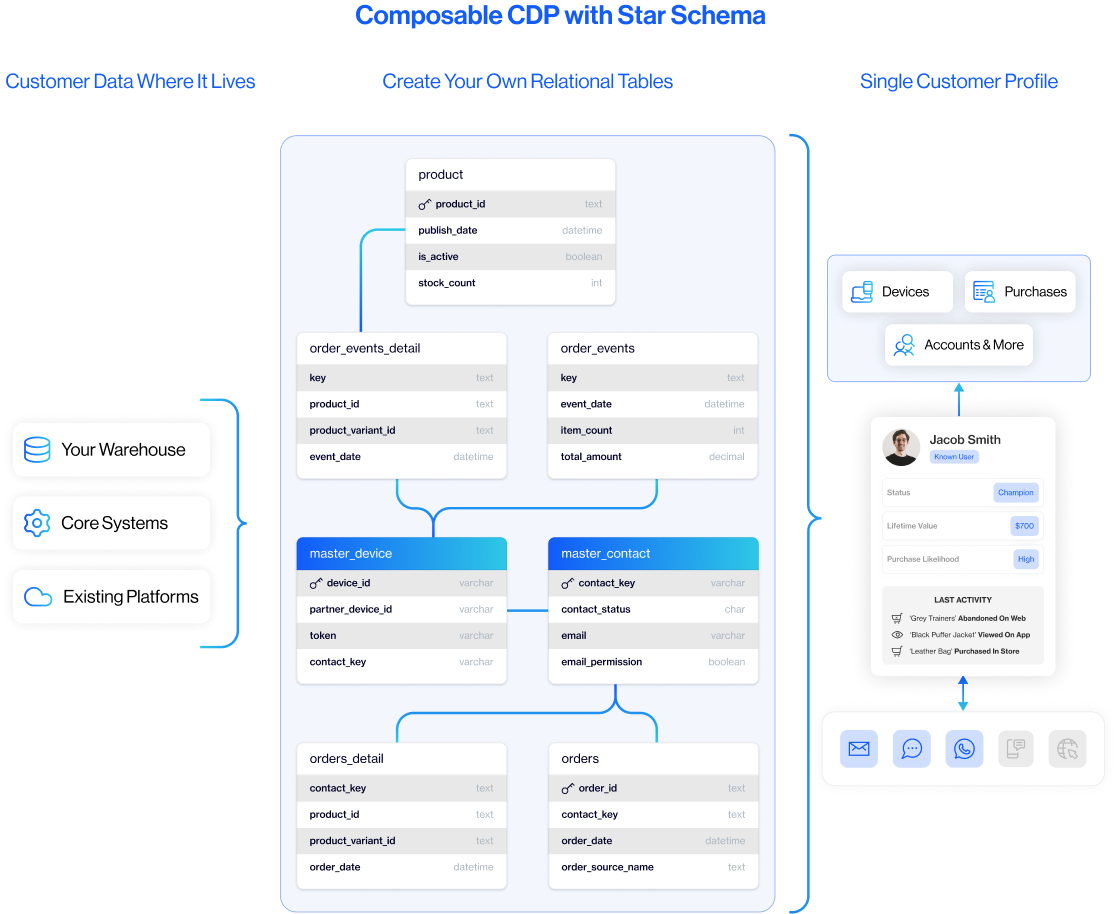
The Tech: A Packaged CDP requires you to “ship” a copy of your customer data into their cloud. A Composable CDP, like D·engage, sits directly on your BigQuery, Snowflake, or Redshift instance.
The Reality: In a packaged setup, your data is essentially “rented” back to you. In a composable setup, the data never leaves your secure perimeter.
The Marketer’s Win: Agility. Because the tool sits on your warehouse, you have instant access to every data point your company owns. You no longer have to wait for “data ingestion” tickets to be cleared by IT before you can use a new customer attribute in a campaign. If the data is in the warehouse, it’s in your hands.
The Tech: Packaged CDPs create a secondary source of truth that exists in parallel to your main database. Composable CDPs recognize the Data Warehouse as the only source of truth.
The Reality: Packaged systems lead to “he said/she said” conflicts. Marketing claims they have 5,000 VIPs; Finance claims there are only 4,200. Composable systems ensure everyone is reading from the same script.
The Marketer’s Win: Credibility. Your campaign reports finally match the CEO’s dashboard. When marketing numbers are 100% consistent with the rest of the business, you build the internal trust necessary to secure more budget and prove real, unarguable ROI.
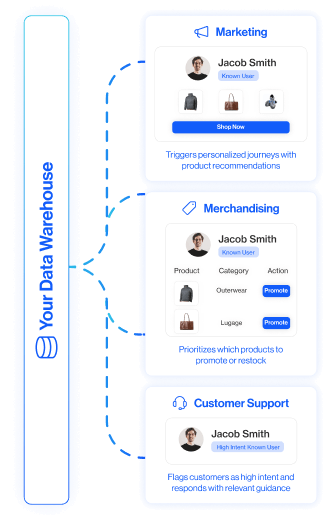
The Tech: Packaged implementation is a cold start. You must map schemas, install proprietary SDKs, and wait for data to pool before you can act. Composable implementation is a warm start, connecting to existing tables in days.
The Reality: With Composable CDPs, you aren’t building a database from scratch; you’re plugging an activation “lightbulb” into an existing power source.
The Marketer’s Win: Speed to Market. You can activate years of historical data on Day 1. You don’t have to wait three months to collect enough behavioral data to build a segment. You can run a “Win-back” campaign against customers who haven’t purchased in two years, five minutes after hitting “Connect.”
The Tech: Packaged CDPs rely on scheduled API syncs, which leads to data drift. Composable CDPs are consistent by design because they query the live warehouse tables directly.
The Reality: If a customer opts out of a category in your app, a packaged CDP might not “know” for hours. A Composable CDP knows the moment the warehouse updates.
The Marketer’s Win: Conversion. You eliminate “Personalization Friction.” No more sending “Abandoned Cart” emails to people who already bought the item an hour ago. By hitting customers with the right message based on their actual current state, your conversion rates climb while your unsubscribe rates drop.
The Tech: Packaged CDPs are “Opinionated,” forcing you into a rigid user/event template. Composable CDPs are Schema-Agnostic, meaning they adapt to however your data is structured in the warehouse.
The Reality: If your business has a complicated data architecture (like B2B hierarchies or multi-brand households), a packaged CDP will struggle to “fit” your data.
The Marketer’s Win: Precision Targeting. You can build hyper-sophisticated segments based on real-world business logic: like “Users associated with a Company Account that has more than 5 open support tickets.” You are no longer limited by a vendor’s basic “User” template; your targeting is as unique as your business.
The Tech: Packaged vendors charge based on the number of profiles (MTUs) you store. Composable CDPs feature Decoupled Pricing, where you pay for activation, not the size of the database.
The Reality: In a packaged model, a growing database means a growing bill, often forcing teams to delete inactive data to save money.
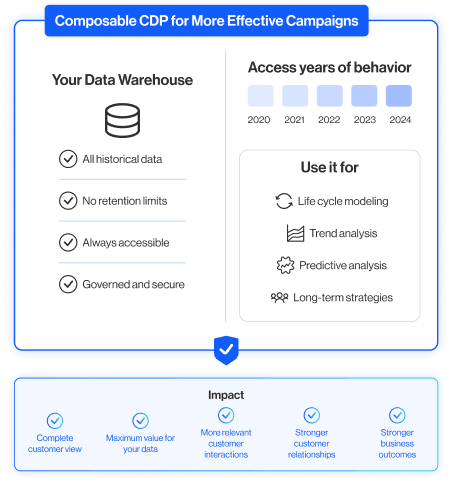
The Marketer’s Win: Scale. You can store and target 100% of your audience without fear of having to delete “inactive” users, allowing you to maintain a complete long-term history for every customer. This deep history is the fuel for better AI-driven LTV (Lifetime Value) modeling.
The Tech: Packaged CDPs require moving PII (Personally Identifiable Information) into a third-party cloud. Composable CDPs maintain Data Sovereignty, keeping all sensitive data within your own secure warehouse.
The Reality: Every new packaged vendor requires a grueling 6-month security audit. Composable tools usually bypass this because the data stays put.
The Marketer’s Win: Risk Mitigation. It’s easier to innovate without the compliance bottleneck. Because you aren’t moving data to new locations, you stay in the “Green Zone” for GDPR and CCPA. You can launch new personalized experiences faster while keeping your customers’ trust (and your Legal team’s approval).
The Single Customer View is only valuable if it is accurate, accessible, and affordable.
While a Packaged CDP offers a “set menu” that feels easy at first, it eventually becomes a bottleneck for brands that want to lead their category.
A Composable CDP (like D·engage) represents the future of marketing: a world where the data warehouse is the center of gravity, and marketing orchestration is the force that puts that data into motion.
Don’t build a second version of your data; activate the one you already have.
Ready to see a Composable CDP in action?
See how leading brands use our platform to enhance performance, improve customer experiences, and achieve measurable business outcomes.
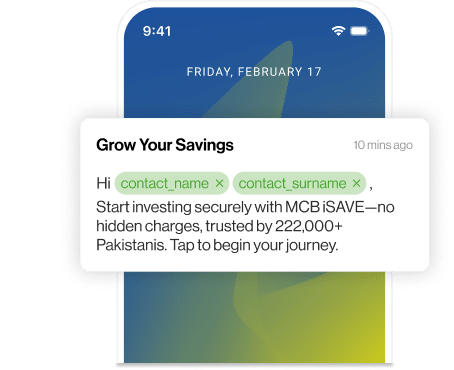
“We boosted our efficiency with D•engage through automation, real-time data sync, and AI-driven targeting, achieving 83% higher account funding and 60% improved operations. All this in just the first year of its integration - This is truly phenomenal”
Monis Usman, EVP Head of Digital Business & Marketing
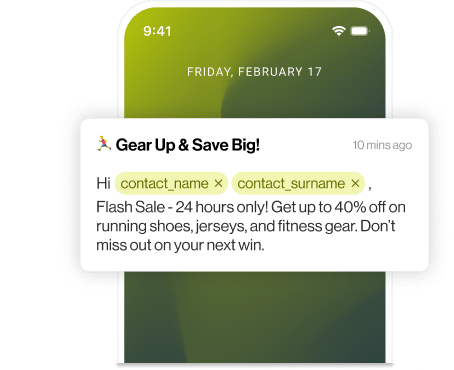
“D·engage’s platform perfectly aligned with Sportive’s business needs. The platform demonstrated superior performance in integrating customer data, generating personalized content, and automation capabilities”
Anıl Can Öztürk, Digital Commerce Director
“Since we started working with D•engage, we’ve gained significant operational efficiency in segmentation, campaign management, and omnichannel communication. We can design personalized campaigns end-to-end through the panel and easily measure content performance with A/B testing.”
Gürhan Öztürk, Communication and Platform Manager

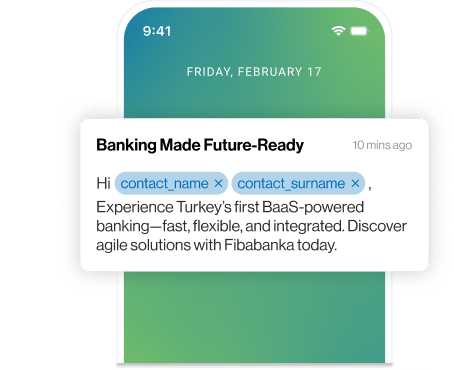
“Sending SMS and email messages without any disruptions is very important in banking processes. Any interruptions can affect our entire sales process. Therefore, the 24/7, high-availability of the platform we use is extremely critical for us.”
Korhan Kocabıyık, Platforms Development Director


Bring all your data, channels, and customers together in one connected platform that works as fast as you do.