The ONLY marketing automation platform with a composable CDP
How are some organizations using AI to deliver incredible customer experiences while others are seeing little more than faster content creation?
The answer isn't that one has access to better AI tools. It's that one has built a more mature AI marketing operation.
Artificial intelligence can only make good decisions when it's built on the right foundation. Without that in place, even the most advanced AI tools struggle to deliver meaningful results. That's why AI maturity matters more than AI adoption.
In this guide, we'll explore the five stages of AI-powered marketing maturity, the common blockers that stop organizations from progressing, and the practical steps you can take to build a composable marketing foundation that's ready for AI.
The Five Stages of AI-Powered Marketing Maturity
Like digital transformation before it, AI maturity develops over time. Organizations progress through distinct stages as they strengthen their customer data, modernize their technology, and embed AI into their everyday marketing workflows.
Each stage serves its own purpose. The goal isn’t to leap from fragmented marketing to fully AI-orchestrated customer experiences overnight. Instead, it’s about building the capabilities that allow AI to become more and more valuable over time.
Understanding where your business sits on that journey is the first step toward deciding what to do next, and which areas to prioritize.
Stage 1: Fragmented Marketing
At the first stage, customer data is spread across multiple systems that don’t communicate effectively with one another. Your CRM, email platform, ecommerce system, loyalty program, customer support software, and analytics tools all hold valuable information, but can’t talk to each other to provide a full view of the customer.
Marketing teams often rely on manual exports, spreadsheets, static audience lists, and broad segmentation to build campaigns. Every decision needs hands-on effort because there is no unified source of truth.
At this stage, AI has very little context to work with. It may be able to generate email copy or summarize reports, but it can’t make meaningful customer decisions because it only sees fragments of the customer journey.
The biggest priority: Connect and unify customer data before investing heavily in advanced AI capabilities.
Stage 2: Connected Marketing
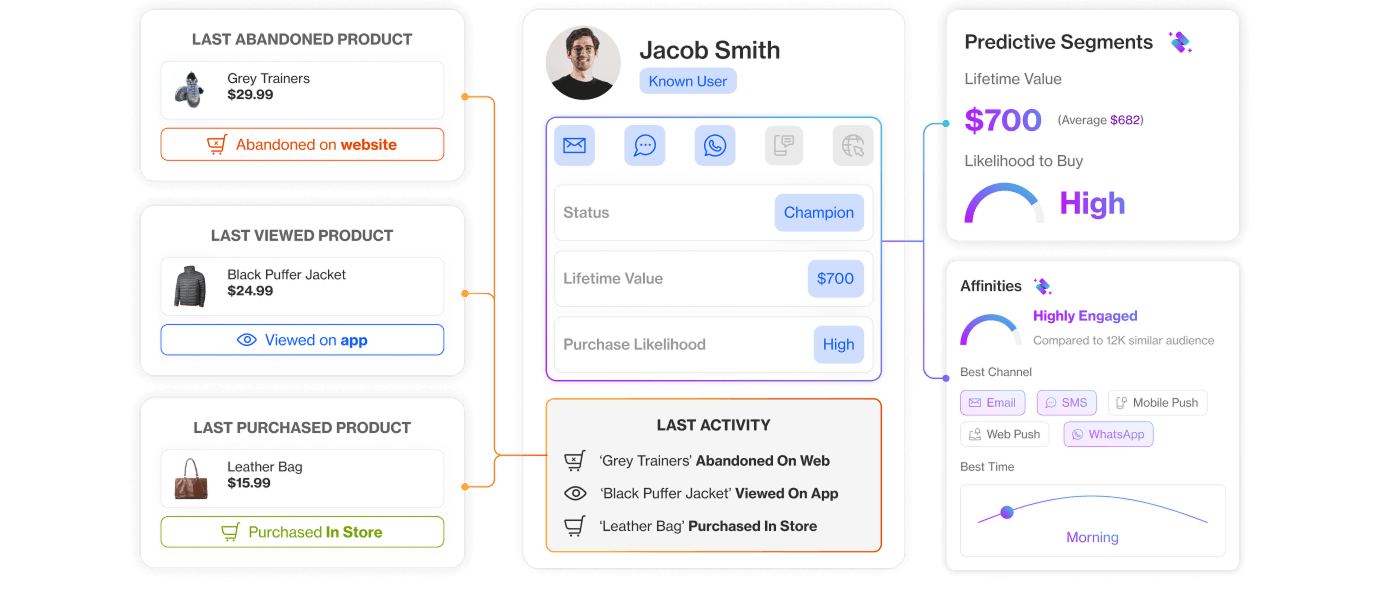
Once customer data is unified, marketers gain a shared understanding of every customer. Something far more valuable than a cleaner database.
Rather than switching between disconnected systems, marketers can work from a single, continuously updated customer profile that combines demographic information, purchase history, behavioral signals, channel engagement, and other relevant interactions.
This creates a strong foundation for AI to begin identifying meaningful patterns across the customer lifecycle.
At this stage, organizations often introduce predictive capabilities such as purchase propensity, churn prediction, customer lifetime value, or product affinity models. AI starts to add intelligence, but marketers still need to spend time deciding how those insights should be used.
The biggest priority: Build confidence in your customer data and begin introducing predictive intelligence.
Stage 3: AI-Assisted Marketing
This is where many organizations find themselves today.
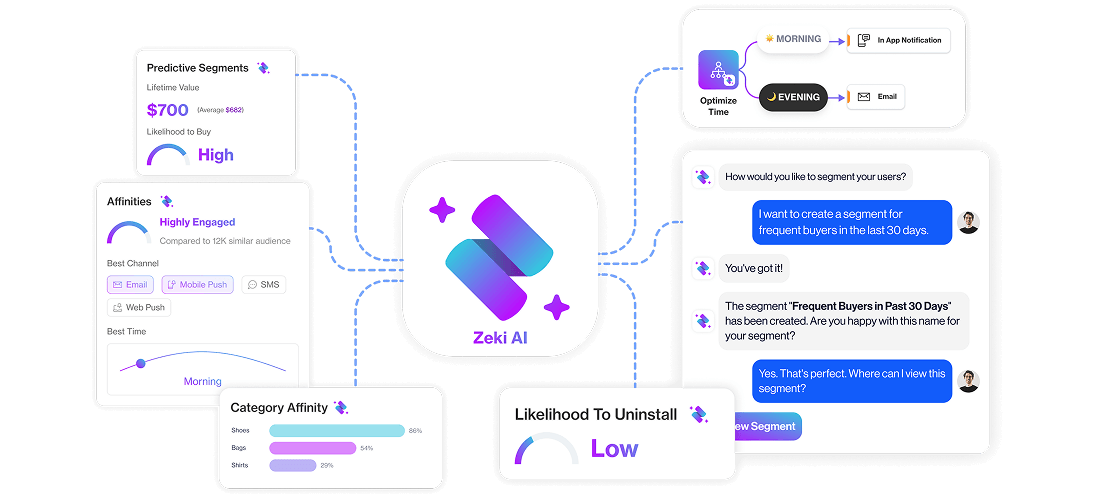
Rather than simply organizing customer information, AI is helping marketers make better decisions. It may recommend audiences, optimize send times, generate content, suggest products, or identify customers most likely to convert.
These capabilities can massively improve efficiency and campaign performance, but they’re still mainly assisting existing marketing processes rather than transforming them.
In most cases, marketers continue deciding who receives campaigns, when they’re sent, and how customer journeys are designed. AI supports those decisions, but rarely changes them automatically.
Embedded AI assistants (like Zeki AI) help marketers move beyond manual analysis by surfacing insights, generating campaign assets, and identifying opportunities that might otherwise be missed.
The biggest priority: Move beyond isolated AI features and begin embedding intelligence throughout your marketing workflows.
Stage 4: Adaptive Marketing
As AI becomes embedded across the marketing stack, campaigns become far more responsive to individual customer behavior.
This is where AI orchestration starts to deliver its greatest value. Rather than simply recommending actions, D·engage can evaluate live customer signals to determine the most appropriate channel, message, timing, or next best action for each individual customer.
The marketer remains firmly in control of strategy and objectives, while AI takes responsibility for making thousands of small optimization decisions that would be impossible to manage manually.
The biggest priority: Allow AI to influence customer decisions in real time rather than simply informing future campaigns.
Stage 5: Continuously Optimized Marketing
At the highest level of maturity, AI becomes an always-on optimization layer across the entire customer experience.
Instead of treating campaigns as individual projects with fixed start and end dates, marketing becomes a system that’s always learning. Every interaction provides new signals that help improve future decisions, allowing campaigns, recommendations, journeys, and customer experiences to become even more effective over time.
At this stage, marketers can spend more time shaping strategy, defining business goals, developing creative ideas, and ensuring every customer experience reflects the brand’s values.
Reaching the final stage of maturity means your marketing is always improving because every decision is backed by better data, better context, and better intelligence than the one before it.
Common Blockers That Slow AI Marketing Maturity
As you’ve seen, progressing through the AI marketing maturity model isn’t a matter of switching on new technology. Many organizations invest heavily in AI tools, only to find they’re unable to move beyond basic use cases because the foundations underneath aren’t ready.
If your AI initiatives aren’t delivering the results you expected, one of these common obstacles might be holding you back.
Disconnected Customer Data
AI is only as effective as the data it can access. When customer information is spread across multiple systems, every prediction and recommendation is based on an incomplete picture.
For example, an AI model may know a customer has abandoned their cart, but not that they’ve already completed the purchase in-store or recently contacted customer support. Without that context, even the most advanced AI can make poor decisions.
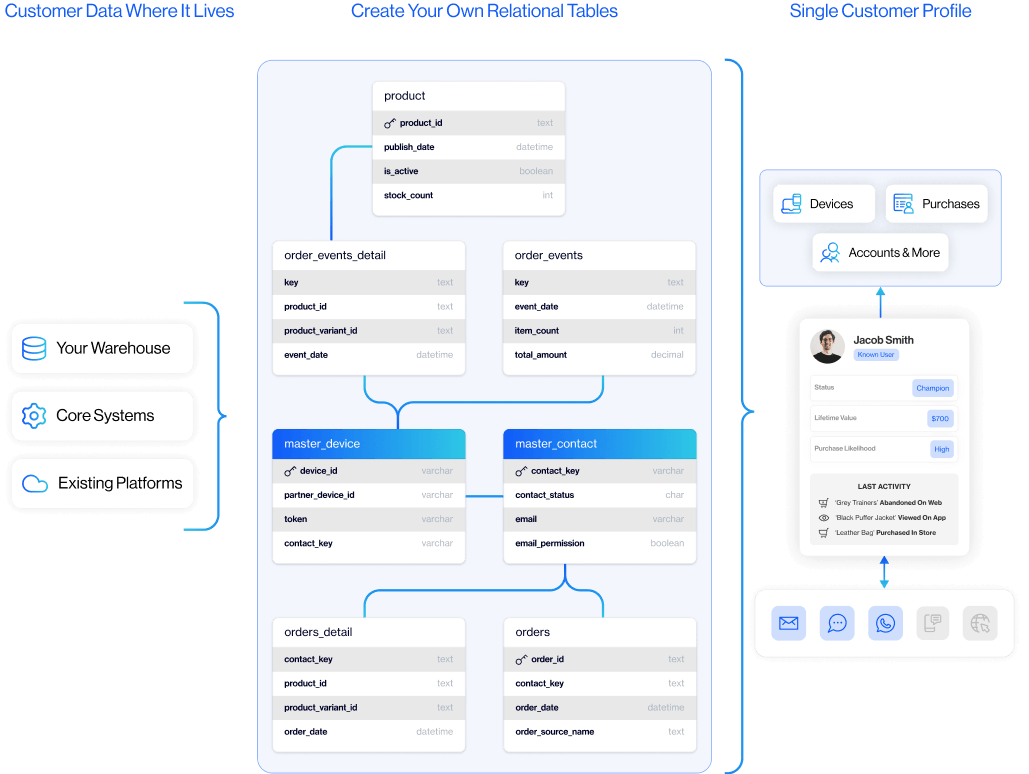
That’s why successful AI strategies begin with unified customer data. D·engage brings together behavioral, transactional, and engagement data into a single, continuously updated customer profile, giving AI the context it needs to make more accurate decisions.
Treating AI as Another Tool
The more deeply you integrate AI into everyday marketing operations, the greater its impact.
The most successful organizations don’t treat AI as an add-on, but as a capability embedded throughout the customer experience.
Rather than operating as a standalone application, AI becomes part of how audiences are selected, journeys are orchestrated, campaigns are optimized, and customer experiences evolve over time.
Static Customer Journeys
Many organizations rely on customer journeys that were designed weeks or months before. While these automated workflows are valuable, they can’t respond when customer intent changes unexpectedly.
As customers browse new products, make purchases, engage with campaigns, or become less active, their needs change. AI orchestration allows journeys to evolve alongside them, adjusting next-best actions using real-time signals instead of predefined rules.
This move from automation to orchestration is often what separates AI-assisted marketing from truly AI-powered marketing.
Chasing 'Shiny Objects' Before Building the Foundation
It’s tempting to focus on the newest capabilities, whether that’s generative AI content to autonomous AI agents. But organizations that try to skip the earlier stages of maturity often end up disappointed.
Without unified data, real-time customer profiles, and connected marketing systems, even the most sophisticated AI models have limited context to work with. Rather than accelerating results, advanced AI simply exposes weaknesses in the underlying marketing infrastructure.
Building strong foundations allows every future AI capability to deliver greater value.
Measuring Technology Instead of Outcomes
Finally, many organizations judge AI success by the number of AI tools they’ve adopted rather than the business outcomes they’ve achieved.
But the real measure of AI maturity is whether you’re creating more relevant customer experiences, improving campaign performance, increasing efficiency, and helping marketers make better decisions.
When organizations focus on customer outcomes instead of tech adoption, it becomes much easier to prioritize the investments that genuinely move them forward.
How to Move Up the AI Marketing Maturity Curve
Once you know where your organization sits on the AI maturity curve, the next challenge is moving forward. That doesn’t mean implementing every new AI capability at once. It means strengthening the foundations that allow AI to make better decisions, deliver better experiences, and create more value over time.
Here are five practical ways to accelerate your AI marketing maturity.
1. Build a Unified Customer View
Before AI can personalize experiences or optimize campaigns, it needs access to a complete and up-to-date picture of every customer. Bringing together behavioral, transactional, demographic, and engagement data creates the context AI relies on to make intelligent decisions.
This is why many organizations begin by investing in a composable CDP. With D·engage, customer data is unified into a single profile that updates continuously as customers interact across channels, creating the foundation for every AI capability that follows.
2. Prioritize Live Customer Context
Customer behavior changes constantly, and AI should be able to respond just as quickly.
Rather than relying on yesterday’s exports or last week’s campaign data, organizations should aim to give AI access to live behavioral signals. Whether a customer has just browsed a product, opened an email, abandoned a basket, or completed a purchase, those interactions should immediately influence future marketing decisions.
The fresher your customer data, the more relevant your AI becomes.
3. Start Small, Then Expand
Not every marketing decision needs AI on day one.
Many organizations see strong early results by introducing AI into a handful of high-impact use cases, such as predictive audiences, product recommendations, or send-time optimization. These quick wins help teams build confidence while demonstrating measurable business value.
As trust grows, AI can gradually support more sophisticated use cases, from journey orchestration to next-best-action recommendations and continuous optimization.
4. Embed AI Into Everyday Marketing
The greatest value comes when AI becomes part of your everyday workflows rather than a separate tool your team occasionally uses.
When AI is embedded directly into campaign creation, customer journeys, segmentation, reporting, and optimization, marketers spend less time on repetitive manual tasks and more time focusing on strategy, creativity, and customer experience.
This is where an integrated platform like D·engage gives you the edge, by combining composable customer data, embedded AI, and orchestration within a single environment instead of requiring multiple disconnected tools.
5. Keep Marketers in Control
Perhaps the biggest misconception about AI maturity is that the end goal is full marketing automation.
In reality, the most mature organizations use AI to enhance human decision-making. AI excels at analysing vast amounts of customer data, identifying patterns, and making thousands of small optimization decisions in real time. Marketers provide the strategic direction, creative thinking, and ethical judgement that AI can’t replicate.
How D·engage Helps You Build AI Marketing Maturity
AI marketing maturity depends on more than adding AI tools to your existing stack. You need the customer data, intelligence, and activation capabilities that allow AI to become progressively more useful as your marketing evolves.
D·engage brings those capabilities together in one platform, unifying customer data into continuously updated profiles and connecting that data directly with embedded AI, segmentation, journey orchestration, and cross-channel marketing automation.
That composable marketing approach gives you a foundation you can build on at every stage of the maturity curve. You can start by creating a unified customer view and introducing targeted AI use cases, then progress toward real-time decisioning, adaptive journeys, and continuous optimization as your capabilities mature.
Rather than repeatedly adding disconnected tools, D·engage allows your data, AI, and activation capabilities to evolve together while keeping marketers in control of the strategy behind them.
Ultimately, AI maturity is measured by how intelligently your marketing can respond to every customer.
Ready to build a more mature AI marketing strategy?
Book a demo to see how you can build a smarter marketing foundation today, and keep evolving it for whatever comes next.
Moments We Help You Own
See how leading brands use our platform to enhance performance, improve customer experiences, and achieve measurable business outcomes.
Case Study
How MCB Funds achieved an 83% boost in account funding
“We boosted our efficiency with D•engage through automation, real-time data sync, and AI-driven targeting, achieving 83% higher account funding and 60% improved operations. All this in just the first year of its integration - This is truly phenomenal”
Monis Usman, EVP Head of Digital Business & Marketing- 83%improvement in account funding ratio
- 30%increase in average transaction size
- 60%improvement in operational efficiency


Case Study
Sportive Increases Transaction Value by 38% with D·engage CRM Integration
“D·engage’s platform perfectly aligned with Sportive’s business needs. The platform demonstrated superior performance in integrating customer data, generating personalized content, and automation capabilities”
Anıl Can Öztürk, Digital Commerce Director- 38%increase in transaction value
- 17%increase in customer shopping frequency
- 21%increase in Google Ads ROAS


Case Study
Beymen drives 30% more clicks and 15% more revenue with D•engage
“Since we started working with D•engage, we’ve gained significant operational efficiency in segmentation, campaign management, and omnichannel communication. We can design personalized campaigns end-to-end through the panel and easily measure content performance with A/B testing.”
Gürhan Öztürk, Communication and Platform Manager- 30%increase in click-through rates
- 15%additional monthly revenue
- 15%time savings in operational processes


Case Study
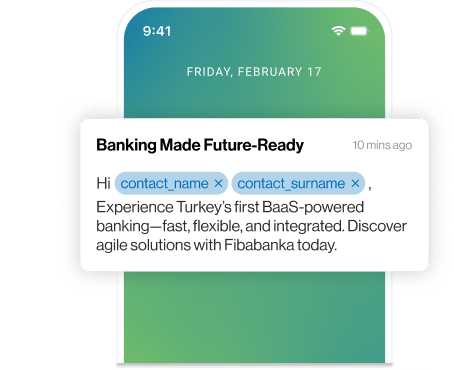
How Fibabanka Achieved 0% Downtime and 35% Cost Savings with D·engage
“Sending SMS and email messages without any disruptions is very important in banking processes. Any interruptions can affect our entire sales process. Therefore, the 24/7, high-availability of the platform we use is extremely critical for us.”
Korhan Kocabıyık, Platforms Development Director- 35%reduction in costs
- 18%reduction in time.
- 0%downtime with on-premise platform

Related Articles
Start Engaging Smarter
Bring all your data, channels, and customers together in one connected platform that works as fast as you do.