The ONLY marketing automation platform with a composable CDP
Composable marketing transformed how organizations collect, connect, and activate customer data. AI is transforming what they can do with it.
For years, these have been treated as separate innovations. Composable architecture solved the challenge of building a flexible, unified marketing ecosystem, while AI promised better predictions, smarter personalization, and more effective decision-making.
But the real opportunity comes when you combine them.
Composable architecture provides the connected, real-time customer data that AI depends on. AI turns that flexible foundation into a marketing engine that continuously learns, adapts, and improves with every customer interaction.
The result is a new generation of customer engagement that's more predictive, more responsive, and far more intelligent than either approach could deliver alone.
Why Composable Marketing Was Made for the AI Era
When composable marketing first emerged, its biggest promise was flexibility.
Organizations could break free from monolithic marketing clouds, unify customer data, and build a technology stack that evolved with their business. Instead of being locked into one vendor’s roadmap, they could connect the tools that made the most sense for their customers.
That was a significant step forward, but it was only half the story. As well as making customer data easier to move, it created the kind of environment marketing AI needs to thrive.
AI performs best when it has access to rich, connected, up-to-date customer data to provide context. It needs to understand not just who a customer is, but what they’ve browsed, what they’ve purchased, how they’ve interacted across channels, and how those behaviors are changing over time.
That’s exactly what composable marketing was designed to deliver. It’s clear now that composable architecture laid the groundwork for a new generation of intelligent marketing, where every prediction, recommendation, and customer journey is powered by a complete view of the customer.
That’s why AI and composable marketing shouldn’t be viewed as separate investments. One creates the conditions that allow the other to deliver meaningful business value.
5 Ways AI Changes Composable Marketing
Instead of simply making marketing more efficient, AI makes it more adaptive, predictive, and responsive. Here are five of the biggest improvements organizations can expect when they combine composable architecture with embedded AI capabilities.
1. 'Segmentation' becomes 'prediction'
Traditional marketing relies on looking backwards.
Marketers build audience segments based on what customers have done in the past: what they’ve bought, what they’ve browsed, and whether they’ve stopped engaging.
Composable AI introduces a forward-looking approach.
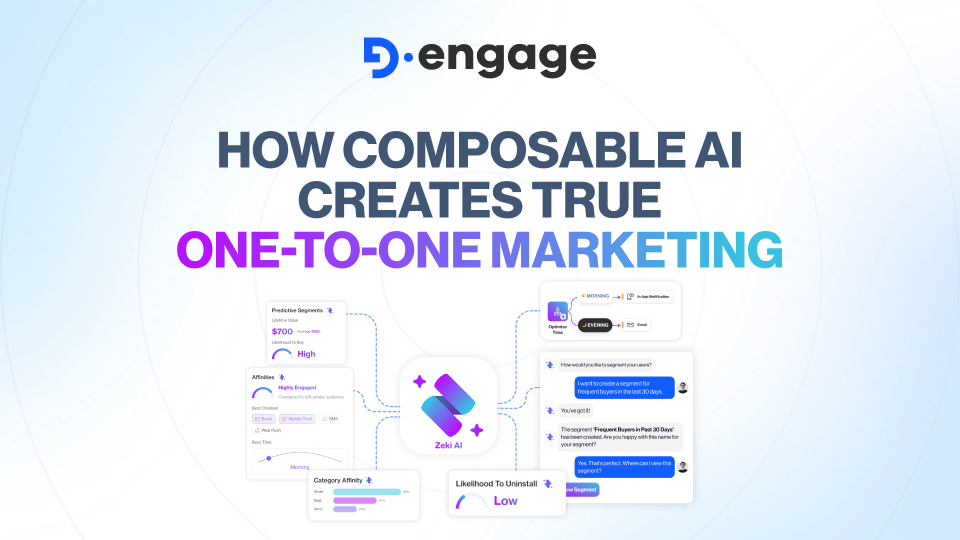
By analyzing patterns across unified customer data, it can identify who is most likely to buy, unsubscribe, churn, or respond to a particular campaign before those outcomes happen. Instead of reacting to customer behavior, marketers can anticipate it and intervene at just the right moment.
The bottom line: more proactive marketing that reaches customers before opportunities are lost.
2. 'Data automation' becomes 'data orchestration'
Marketing automation used to rely on predefined rules.
If a customer completes an action, they enter a journey. If they don’t, they follow a different path. While effective, these journeys only respond to scenarios marketers have planned in advance.
AI introduces a new level of adaptability.
Rather than following a fixed sequence of rules, journeys can respond dynamically to changing customer behavior, engagement signals, and predictive insights. Timing, messaging, channels, and next-best actions become more responsive because they’re informed by real-time customer context.
The bottom line: Instead of automating static workflows, marketers can orchestrate customer experiences that evolve as customers do.
3. 'Personalization' becomes 'individualization'
Composable marketing makes it easier to deliver personalized experiences across channels using unified customer profiles, and AI takes that one step further.
Rather than serving content based on broad audience segments, AI can evaluate each customer’s unique preferences, intent, and context to decide what message, product recommendation, offer, or channel is most relevant at that precise moment.
The bottom line: Every interaction becomes more timely, contextual, and individually relevant because AI continuously adapts experiences using the data already available.
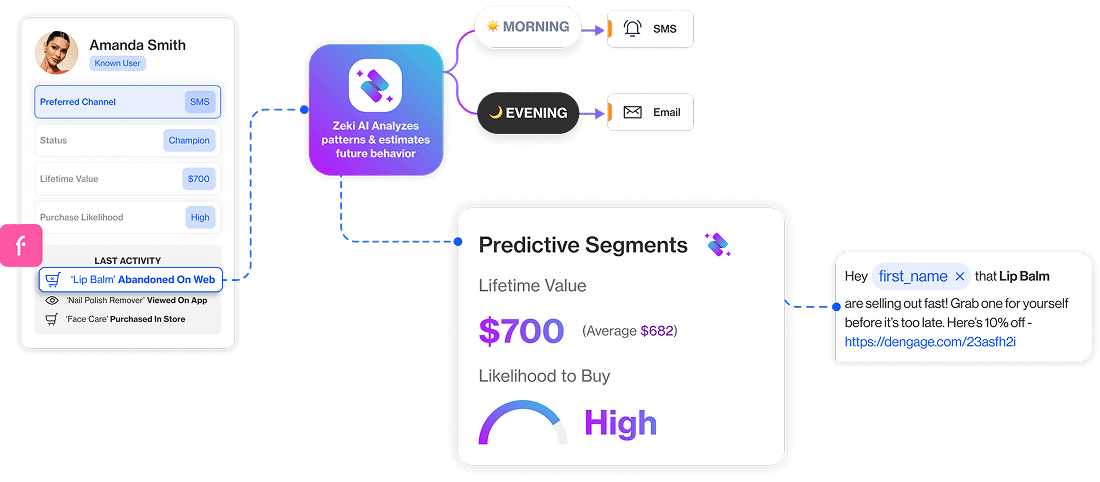
4. 'Reporting' becomes 'continuous optimization'
Campaign reporting has traditionally been retrospective, as teams need to wait for campaign results and insights to improve the next campaign.
When you introduce embedded AI tools to the mix, the feedback loop shortens dramatically.
By monitoring campaign performance as it happens, AI can identify emerging trends, detect anomalies, surface optimization opportunities, and recommend adjustments while campaigns are still running. Instead of waiting until performance declines, marketers can respond in real time.
The bottom line: Optimization becomes an ongoing process rather than a post-campaign exercise.
5. 'Connected systems' become 'connected intelligence'
Composable marketing can connect technologies, but AI can connect decisions.
Instead of each marketing capability operating independently, customer insights generated in one part of the platform can immediately influence decisions across every other touchpoint.
A customer’s likelihood to churn might influence product recommendations, journey orchestration, channel selection, campaign timing, and messaging all at the same time.
The bottom line: Everyone benefits from a connected intelligence layer that helps every part of the customer experience work together more effectively.
As organizations continue investing in composable marketing, the ability to make smarter decisions with every customer interaction may prove to be the biggest transformation of all.
How AI-Powered Composable Marketing Works
Imagine a customer browsing a website for a new pair of running shoes.
They view several products, compare different styles, and read a handful of reviews before leaving without buying anything.
At first glance, it looks like another abandoned browsing session.
Behind the scenes, however, an AI-powered composable marketing platform is already piecing together a much richer story.
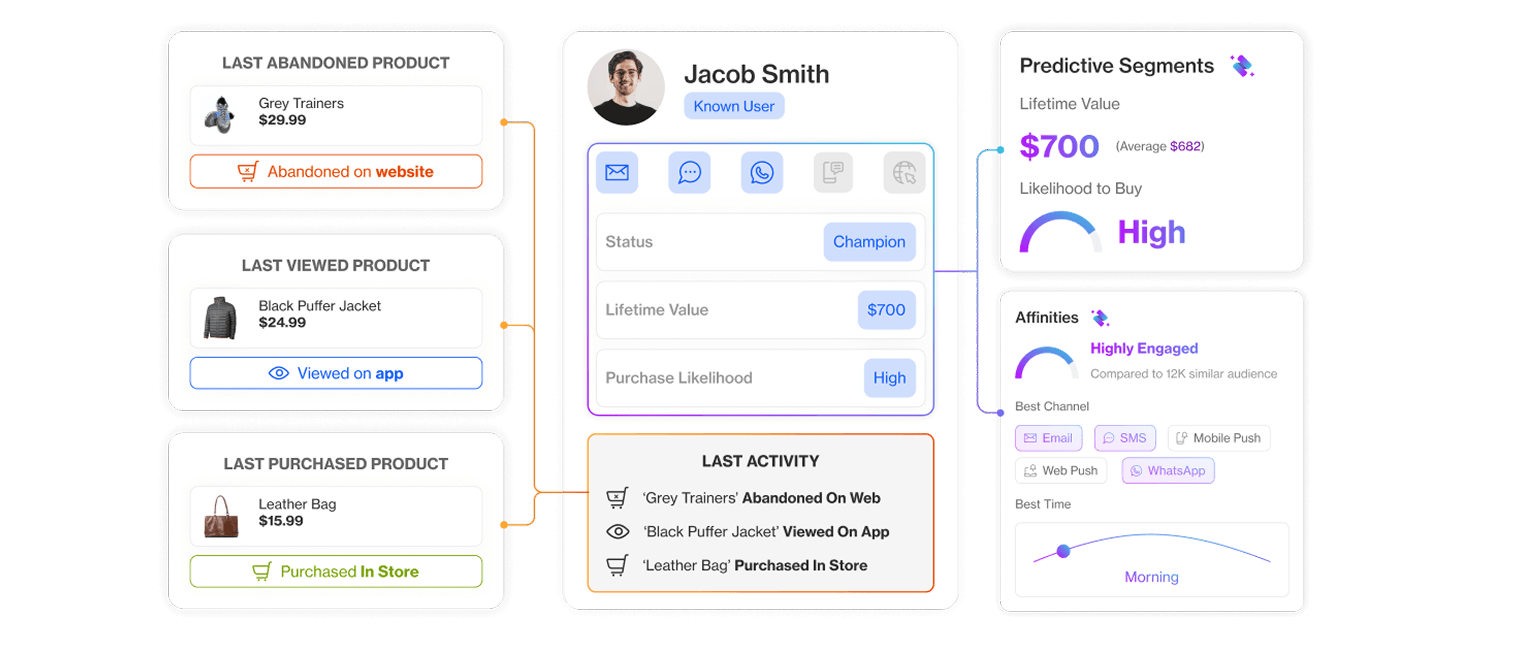
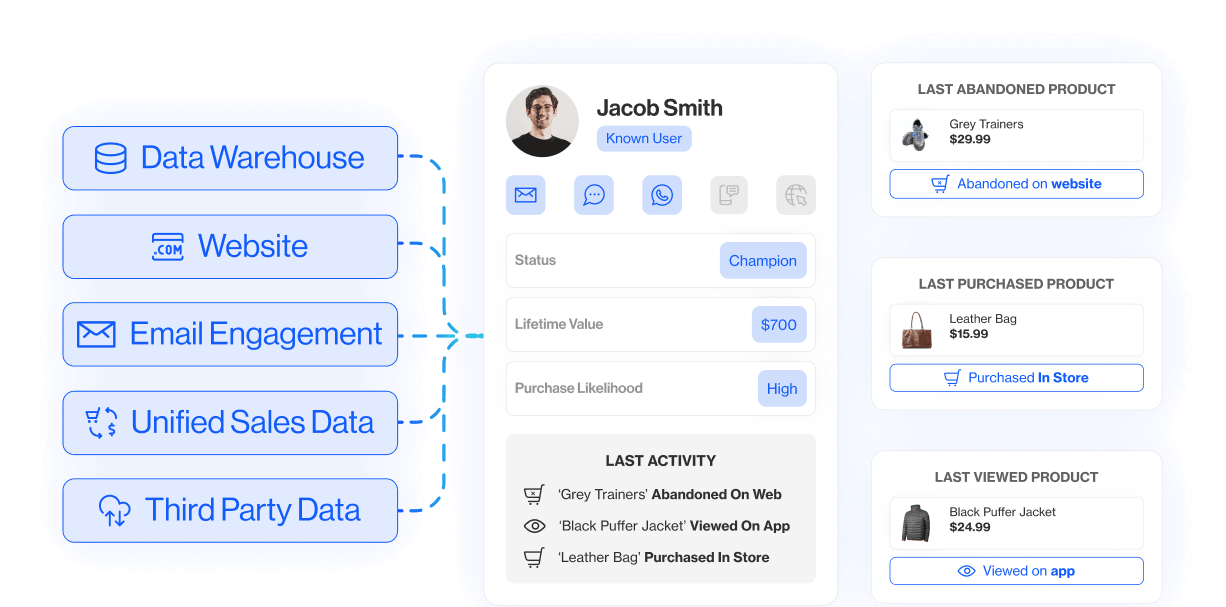
Every interaction updates the customer’s unified profile in real time. Their browsing behavior joins purchase history, loyalty status, email engagement, mobile app activity, and previous customer service interactions to create a complete, up-to-date picture of who they are and what they’re trying to achieve.
AI analyzes that context alongside thousands of similar customer journeys. Rather than simply recognizing that someone viewed a product, it identifies signals that suggest strong purchase intent, predicts the likelihood of conversion, and recommends the next best action.
Instead of automatically sending the same abandoned cart email every customer receives, the platform can make a more informed decision.
Perhaps it waits until the customer is most likely to engage, or recommends complementary products based on previous purchases. Or maybe it suppresses promotional messaging altogether because the customer has already purchased through another channel.
Instead of experiencing a series of disconnected campaigns, the customer experiences one continuous conversation.
As the journey continues, every new interaction feeds back into the system. If the customer opens an email but doesn’t click, revisits the website from a social ad, downloads the mobile app, or completes their purchase in-store, composable AI immediately incorporates that information into future decisions.
Without composable marketing, customer data remains fragmented across systems, limiting AI’s ability to understand the complete customer journey.
Without AI, unified customer data still relies on marketers to interpret it and decide what should happen next.
Together, they create something powerful: a marketing system that learns from every single interaction and becomes smarter with every customer it serves.
How to Build an AI-Powered Composable Marketing Strategy
The customer journey we just explored isn’t powered by a single AI feature. It’s the result of multiple capabilities working together, from unified customer data and predictive intelligence to journey orchestration and continuous learning.
D·engage brings these capabilities together within a single platform. But for most organizations, realizing their full potential is a journey rather than a single milestone.
Stage 1: Build a unified customer foundation
Everything starts with customer data.
Before AI can deliver meaningful insights, you need a complete, connected view of every customer. Without this foundation, AI is forced to make decisions using fragmented or incomplete information.
This is why D·engage’s composable customer data foundation sits at the heart of its platform. By unifying customer data from across the business, it gives every AI capability access to the complete context needed to make smarter decisions.
Stage 2: Make customer data real-time
A complete customer profile is only valuable if it reflects what’s happening right now.
Customer intent can change in minutes. Someone browsing products during their lunch break may be ready to purchase that evening. A loyal customer who suddenly stops engaging may already be showing the first signs of churn.
D·engage’s Smart Insights continuously monitor customer behavior as it happens, helping marketers respond to changing engagement signals instead of relying on yesterday’s data. This real-time customer intelligence ensures AI always has the latest context, allowing marketing decisions to adapt as customer behavior changes, not hours or days later.
Stage 3: Introduce predictive intelligence
Once organizations have reliable customer data flowing through the platform, AI can begin identifying patterns that humans would struggle to detect at scale.
Instead of simply reporting on what customers have already done, predictive models estimate what they’re likely to do next.
This is often the point where organizations begin moving from reactive marketing to proactive customer engagement.
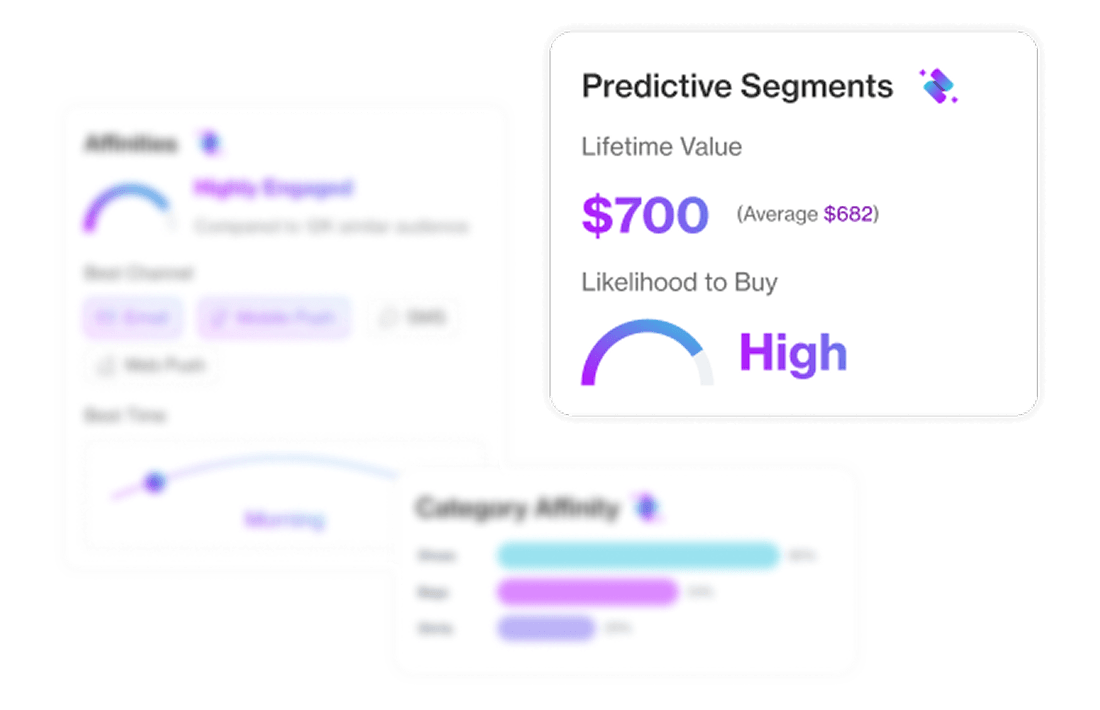
And rather than asking marketers to build predictive models themselves, D·engage’s embedded AI, powered by Zeki AI, helps identify likely outcomes such as purchase intent, churn risk, and next-best actions using continuously updated customer data.
Stage 4: Turn predictions into action
Predictions only become valuable when they’re translated into action. D·engage connects AI insights directly to customer journeys, allowing marketers to orchestrate more relevant experiences across channels rather than relying solely on predefined rules.
Campaign timing, messaging, channel selection, recommendations, and next-best actions all become informed by the customer’s latest behavior rather than fixed rules or manual decisions.
At this stage, marketing becomes far more adaptive because customer journeys evolve alongside the customer.
Stage 5: Create a system that learns
Every campaign, recommendation, conversion, and customer interaction generates new data that feeds back into the system. Over time, AI becomes more accurate, customer journeys become more relevant, and marketing decisions improve continuously.
As campaigns run, performance data feeds back into the platform, helping marketers refine audiences, improve recommendations, and make future decisions with greater confidence.
How organizations typically evolve and how D·engage supports every stage.
| Stage | Focus | How D·engage Helps |
|---|---|---|
| 1. Connect | Build a unified customer view | Composable customer data unifies profiles across channels and systems. |
| 2. Understand | Capture real-time customer behavior | Smart Insights continuously enrich customer context with live behavioral signals. |
| 3. Predict | Anticipate customer needs | Zeki AI identifies churn risk, purchase intent, next-best actions, and other predictive insights. |
| 4. Engage | Turn insights into personalized experiences | Journey orchestration, Segment Shaper, recommendations, and AI-generated content activate those insights across every channel. |
| 5. Improve | Learn from every interaction | Campaign performance continuously informs future predictions and optimization. |
Why D·engage Is Built for AI-Powered Composable Marketing
AI-powered composable marketing requires more than simply bolting a new AI tool onto an existing platform. It requires a marketing ecosystem where connected customer data, predictive intelligence, journey orchestration, and continuous learning are designed to work together from the outset.
That’s the approach D·engage takes. The composable customer data foundation brings together information from across the customer journey, creating the unified, real-time profiles that intelligent decision-making depends on. Rather than treating customer data as something that’s collected and stored, D·engage turns it into an active source of insight that continuously informs marketing decisions.
Building on that foundation is Zeki AI, D·engage’s embedded intelligence layer. Instead of operating as a standalone assistant, Zeki works across the platform to help marketers predict customer behavior, identify high-value audiences, generate relevant content, surface actionable insights, and recommend the next best action based on each customer’s unique context.
Those insights don’t remain trapped inside dashboards, either.
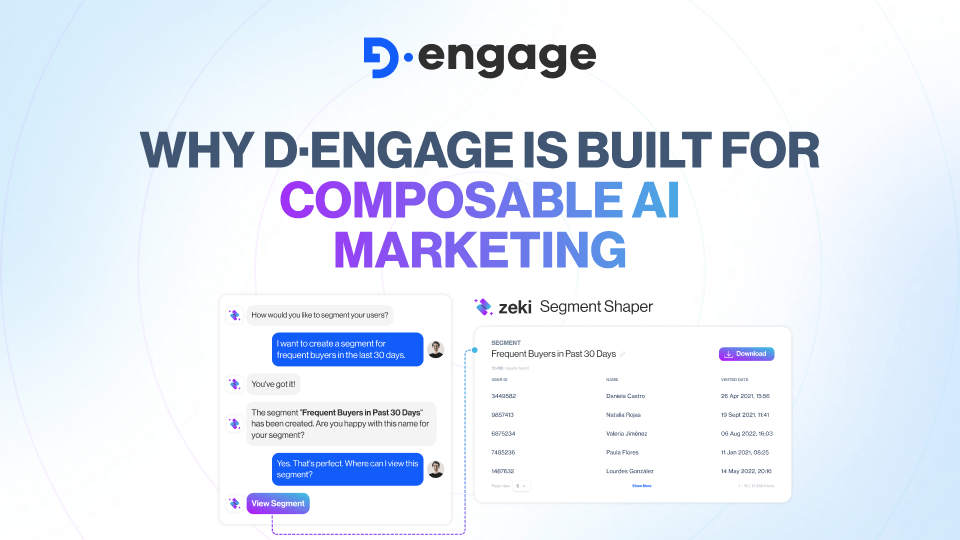
Capabilities like Segment Shaper, Smart Insights, AI-powered recommendations, journey orchestration, and AI-generated content work together to translate intelligence into action. As customer behavior changes, audiences update, journeys adapt, recommendations evolve, and marketers receive the insights they need to respond without having to leave the platform.
This creates a marketing ecosystem where data, intelligence, and activation continuously reinforce one another.
The Future of Composable AI Marketing
As AI continues to evolve, so will composable marketing.
The next generation of marketing platforms will become more and more effective at recognizing patterns, connecting insights across channels, and recommending actions that help marketers deliver better customer experiences.
That doesn’t mean marketing will become fully autonomous: far from it.
Successful organizations will continue to rely on marketers to define strategy, understand their customers, shape their brand, and make the decisions AI can’t. The role of AI is to expand what’s possible, not replace the people responsible for creating meaningful customer relationships.
As AI becomes more deeply embedded within composable marketing platforms, we can expect several important changes:
- Campaign optimization will become more proactive, with AI identifying opportunities before performance begins to decline.
- Customer journeys will become more adaptive, responding to changes in behavior and intent with greater speed and precision.
- Cross-channel experiences will feel more connected as decisions made in one touchpoint immediately influence the next.
- Marketers will spend less time manually analysing data, building audiences, and maintaining complex workflows, and more time focusing on strategy, creativity, experimentation, and customer experience.
Organizations that have invested in composable architecture are already well positioned for this future. Because their customer data, integrations, and marketing capabilities are built on a flexible foundation, they’re able to adapt to new AI innovations as they emerge without rebuilding their customer engagement strategy from scratch.
Ready to Build a More Intelligent Marketing Strategy?
Whether you’re exploring composable customer data, embedded AI, or how both technologies work together, D·engage provides the foundation to help your marketing become more connected, more predictive, and more intelligent.
Book a personalized demo to see how D·engage combines composable architecture with embedded AI to power the next generation of customer engagement.
Or, if you’re just starting your journey, explore our previous guides to Composable CDPs and Zeki AI to learn more about the technologies behind AI-powered composable marketing.
Moments We Help You Own
See how leading brands use our platform to enhance performance, improve customer experiences, and achieve measurable business outcomes.
Case Study
How MCB Funds achieved an 83% boost in account funding
“We boosted our efficiency with D•engage through automation, real-time data sync, and AI-driven targeting, achieving 83% higher account funding and 60% improved operations. All this in just the first year of its integration - This is truly phenomenal”
Monis Usman, EVP Head of Digital Business & Marketing- 83%improvement in account funding ratio
- 30%increase in average transaction size
- 60%improvement in operational efficiency


Case Study
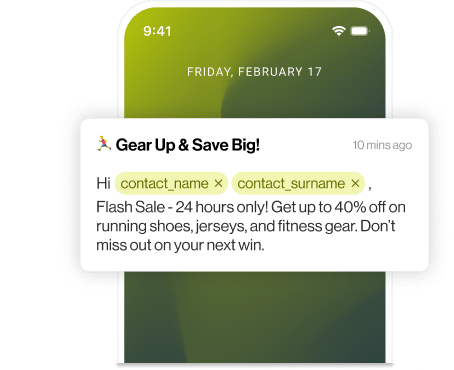
Sportive Increases Transaction Value by 38% with D·engage CRM Integration
“D·engage’s platform perfectly aligned with Sportive’s business needs. The platform demonstrated superior performance in integrating customer data, generating personalized content, and automation capabilities”
Anıl Can Öztürk, Digital Commerce Director- 38%increase in transaction value
- 17%increase in customer shopping frequency
- 21%increase in Google Ads ROAS

Case Study
Beymen drives 30% more clicks and 15% more revenue with D•engage
“Since we started working with D•engage, we’ve gained significant operational efficiency in segmentation, campaign management, and omnichannel communication. We can design personalized campaigns end-to-end through the panel and easily measure content performance with A/B testing.”
Gürhan Öztürk, Communication and Platform Manager- 30%increase in click-through rates
- 15%additional monthly revenue
- 15%time savings in operational processes


Case Study
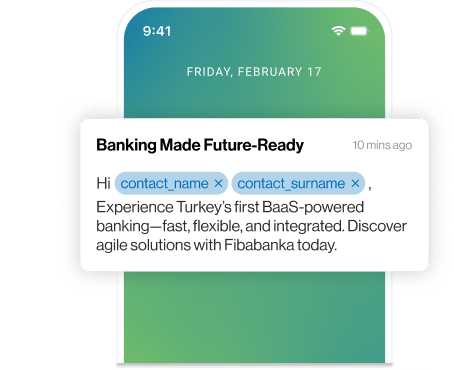
How Fibabanka Achieved 0% Downtime and 35% Cost Savings with D·engage
“Sending SMS and email messages without any disruptions is very important in banking processes. Any interruptions can affect our entire sales process. Therefore, the 24/7, high-availability of the platform we use is extremely critical for us.”
Korhan Kocabıyık, Platforms Development Director- 35%reduction in costs
- 18%reduction in time.
- 0%downtime with on-premise platform

Related Articles
Start Engaging Smarter
Bring all your data, channels, and customers together in one connected platform that works as fast as you do.