The ONLY marketing automation platform with a composable CDP
The era of “copy everything into the CDP” is over. Here’s what comes next.
Most enterprise customer data already exists inside the organization. The real problem is how difficult it is to use.
For many businesses, the data lives in multiple places: transaction histories sit inside data warehouses, loyalty data lives in separate platforms, and product holdings remain trapped in core banking systems, CRMs, and legacy enterprise databases.
Before most CDPs can use any of that data, it has to be extracted, duplicated, transformed, and synced into the platform itself. And that duplication layer has become one of the biggest hidden costs in modern marketing infrastructure.
Every copied dataset increases storage costs, creates more governance overhead, and adds another pipeline that IT teams need to maintain. Worse, the moment data is copied, it starts going stale.
For regulated industries, every duplicated customer record expands the compliance surface area: making governance, deletion workflows, and data residency harder to manage.
This is where remote sourcing comes in. This architectural approach allows marketers to segment, personalize, and activate customer data directly from existing systems without replicating it into the CDP first.
The problem with CDPs forcing you to move your data
Most CDPs were built around the core assumption that, before the platform can do anything with your customer data, it needs its own copy of it.
That means data from all of your internal sources needs to be extracted, transformed, and loaded into the CDP through APIs, ETL pipelines, or scheduled imports.
Years ago, that model was manageable because customer data lived in fewer places, moved more slowly, and was easier to centralize. But enterprise data environments no longer work like that.
Today, customer data is spread across cloud warehouses, legacy databases, regional systems, and streaming infrastructure. Instead of simplifying that complexity, traditional CDP architecture often creates a second data estate that needs to be maintained and governed alongside the original.
And that’s the important point: this isn’t an implementation issue. It’s a structural one. Most CDPs assume they should sit at the center of the enterprise data ecosystem but, for most organizations, they don’t.
Stale data means broken campaigns
The moment customer data is copied into another platform, it starts falling behind reality.
Let’s say a customer upgrades their account at 9am. The CDP synced overnight, so the platform still sees their old subscription tier. At midday, a campaign sends them an offer they no longer qualify for.
This is the hidden limitation behind many “real-time” marketing claims. The messaging layer may operate instantly, but the data underneath it is often hours — or even days — old.
The more dynamic the business, the more visible the gap becomes.
The IT bottleneck nobody talks about
Every new dataset inside a traditional CDP usually requires a new pipeline, schema mapping, testing process, and ongoing maintenance cycle.
Marketing wants to target customers who own a certain product and recently opened a support ticket. The data exists, but it sits across multiple systems. Suddenly a campaign request becomes a development project.
The result is a dependency most marketing teams know well: either wait weeks for IT support, or work with incomplete data because it’s already available in the platform.
Neither is a good option.
Governance issues grow with every duplication
Every duplicated customer record creates another governance responsibility.
That copy now needs its own access controls, security policies, deletion workflows, and compliance oversight. Under frameworks like the GDPR, every replicated dataset expands the compliance surface area.
For regulated industries, this becomes a major concern, not just an inconvenience. In many cases, legal and compliance teams are less worried about the CDP itself than the fact it requires sensitive customer data to be copied into another environment.
The irony is hard to ignore: the platform designed to help organizations use customer data more effectively can also make that data harder to control.
Traditional CDP ingestion vs. remote sourcing
| Traditional CDP ingestion | D·engage remote sourcing | |
|---|---|---|
| Storage | Customer data is copied and stored inside the CDP | Customer data remains in the existing warehouse or enterprise system |
| Latency | Data freshness depends on sync schedules and batch imports | Segments query live data at execution time |
| Governance surface area | Every duplicated dataset creates additional compliance and security overhead | Governance remains within the existing infrastructure |
| IT dependency | New campaigns often require pipelines, schema mapping, and engineering support. | Data is connected once, then marketers can self-serve. |
| Time to first campaign | New data sources can take weeks or months to activate | Connected data is immediately available for segmentation and activation. |
“With the Remote Source feature, we can integrate various data sources without needing the data to reside within the platform, and use this data to create complex segments.”
Gürhan Öztürk
Communication and Platform Manager @ Beymen
Beymen used D·engage’s remote sourcing capabilities to centralize fragmented customer data, improve segmentation agility, and drive a 30% increase in click-through rates alongside a 15% increase in revenue.
What is remote data sourcing?
Instead of extracting customer data from your systems, transforming it, and loading it into the platform, remote data sourcing allows the platform to connect directly to your existing infrastructure and query the data where it already lives.
That data might sit in a cloud warehouse, a core banking platform, an enterprise database, or a real-time streaming environment. The important difference is that the data stays there. The platform reads it, uses it for segmentation and activation, and never creates another copy.
Architecturally, this is a completely different relationship between the CDP and enterprise data.
Traditional CDPs behave a bit like old external hard drives. To use the data, you have to move files back and forth constantly. The moment something changes in the source system, the copy inside the platform starts drifting out of sync.
Remote sourcing works more like the cloud. There’s one live version of the data, and the platform accesses it directly when needed.
What this means in practice
For marketers, it means campaigns can reference live enterprise data without waiting for imports or sync cycles.
A segment can pull transaction history from BigQuery, loyalty data from Redshift, and product information from Oracle without any of those datasets being stored inside the CDP itself.
When the source data changes, the segment automatically reflects the latest state the next time it runs.
For IT and data teams, the operational difference is just as important. Instead of building and maintaining a growing network of pipelines, they configure the connection once and the platform queries the data on demand.
How this differs from “just connecting an API”
This is where many enterprises get confused.
Most API integrations still work by pulling data into the CDP on a schedule. The integration may look modern, but the underlying model is still ingestion and storage.
Remote sourcing is fundamentally different because the platform doesn’t import the data: it queries it.
The source system remains the source of truth, with its own governance, security, and access controls intact. The CDP receives the answer to a query, not a replicated dataset.
Where remote sourcing fits in the broader architecture
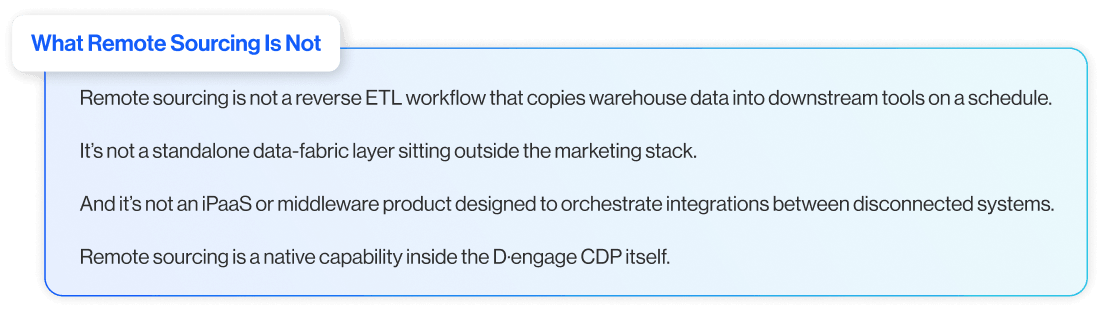
Remote sourcing is a foundational part of composable CDP architecture.
In a composable model, the warehouse remains the center of the data ecosystem. Remote sourcing is the mechanism that allows the activation layer (segmentation, personalization, and campaigns) to work directly against that source of truth without duplicating it first.
Rather than replacing enterprise infrastructure, the platform is designed to work with it.
How D·engage’s remote sourcing works
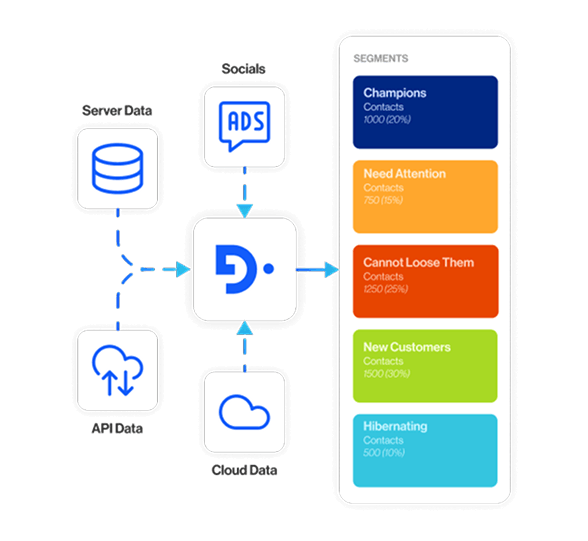
D·engage’s remote sourcing architecture starts with direct connections to the systems where enterprise customer data already lives.
That includes cloud warehouses like Google BigQuery and Amazon Redshift, enterprise and legacy databases including Oracle, Microsoft SQL Server, SAP HANA, MySQL, PostgreSQL, Dremio, and Teradata, as well as streaming platforms like Apache Kafka.
This matters because enterprise data environments are rarely standardized around a single system. Customer data is usually spread across warehouses, transactional databases, and real-time event streams simultaneously.
Most platforms support one or two of these environments, but D·engage supports all three natively.
The setup process is intentionally straightforward. Warehouses connect through credential-based authentication, relational databases use standard server and access configurations, and Kafka supports enterprise-grade security methods including SSL and SASL authentication.
Once configured, the remote source becomes a persistent live connection that D·engage can query on demand. It isn’t an import job or a scheduled sync, but a direct link into the existing data infrastructure.
Remote tables make external data part of your data model
This is where the architecture becomes especially powerful.
A remote table is a virtual representation of an external database table inside D·engage’s star schema. The platform mirrors the table structure of columns, fields, and data types without copying the underlying data itself.
That table is then linked to the master contact table through a shared contact key, allowing external data to behave like a native part of the customer model.
For marketers, the complexity disappears entirely. Remote tables appear alongside local tables inside the segmentation interface and can be used through the same drag-and-drop experience as any other dataset.
That means a marketer can build audiences using transaction data from BigQuery, product ownership data from Oracle, or loyalty data from Redshift without writing SQL or asking IT to create another pipeline.
Remote tables also support device-level mapping, allowing businesses with large-scale behavioral event data to segment audiences based on live device activity across mobile and digital experiences.
Remote segments can query live data at execution time
Remote segments take the idea even further.
Instead of building audiences from imported data stored inside the platform, D·engage can execute segmentation queries directly against the external source at the moment the segment runs.
If a customer’s status changes inside the warehouse five minutes before a campaign launches, the segment reflects that updated state automatically.
Technical users can create these segments with SQL for maximum flexibility, while non-technical marketers can use the interactive segment builder with remote table filters. Both approaches access the same live data.
Because remote segments also work inside automated journeys and lifecycle orchestration, the benefits extend beyond campaigns into always-on personalization and real-time engagement flows.
How the three work together
Together, Remote Sources, Remote Tables, and Remote Segments form a complete remote activation layer:
- Remote Sources establish the live connection to enterprise infrastructure.
- Remote Tables make external datasets available inside D·engage’s relational model.
- Remote Segments query that data live at execution time.
In practice, the workflow is simple: the data team connects the source once and maps the required tables once. From that point onward, marketers can self-serve against live enterprise data without waiting on IT, building pipelines, or managing sync schedules.
Most importantly, the data never leaves the client’s infrastructure. No duplicate dataset is created, no secondary storage layer is introduced, and governance remains inside the organization’s existing security and compliance framework.
The business impact of activating data without duplication
1. Cost
The cost of data duplication is easy to underestimate because it rarely appears in one place.
There’s the storage cost of maintaining copies of enterprise data inside the CDP, the infrastructure cost of running the ETL pipelines that keep those copies synchronized, and there’s the engineering cost. You have whole data teams spending time maintaining integrations, troubleshooting sync failures, and updating schemas every time a source system changes.
At enterprise scale, those costs quickly compound. Remote sourcing makes that entire layer unnecessary.
For organizations that have already spent heavily building governed cloud infrastructure, this is a significant boon. Rather than paying to recreate the same data estate inside a CDP, they can activate the infrastructure they already own.
2. Speed to campaign
In many organizations, the gap between “we have this data” and “we can use this data in a campaign” is measured in weeks.
Remote sourcing completely removes the gap.
Once the source is connected and mapped, the data is available for segmentation and activation immediately. This allows marketing teams to move faster, test new use cases sooner, and launch campaigns around live business opportunities instead of waiting for infrastructure work to catch up.
Just as importantly, the dependency model changes. Data engineering configures the connection once. From that point onward, marketers self-serve.
3. Data freshness
This is what makes true real-time marketing possible.
When campaigns rely on imported data, there’s always uncertainty around whether the customer state is still accurate. The platform may be working from a snapshot captured hours earlier.
Remote sourcing queries the live source system at execution time. The segment reflects the current state of the customer, not the state captured during the last sync cycle.
For fast-moving industries like financial services, retail, telco, and iGaming, that difference reduces irrelevant messaging, improves personalization accuracy, and lowers the risk of campaigns reacting to outdated customer behavior.
The “right message, right time” promise only works if the underlying data is current.
4. Data governance
Under GDPR and other regulatory frameworks, replicated datasets increase the compliance surface area around access control, deletion workflows, audit logging, and residency requirements.
Remote sourcing reduces that burden because the data never leaves the source environment. Governance, encryption, and security controls remain inside the organization’s existing infrastructure and policies.
Use cases: how regulated industries run real-time marketing
The value of remote sourcing becomes clearest in industries where customer data is complex, sensitive, and constantly changing. These examples show what happens when organizations can activate live enterprise data without duplicating it first.
Financial services: activating live banking data without moving it
For financial institutions, customer data is rarely stored in one place: core banking data often sits in legacy Oracle or Microsoft SQL Server environments, transactional activity streams through separate systems, and customer engagement and analytics data lives somewhere else entirely.
Marketing teams see the value in connecting those signals, but traditional CDP architecture creates a problem immediately: moving sensitive financial data into another platform introduces governance, security, and compliance concerns that many banks are unwilling to accept.
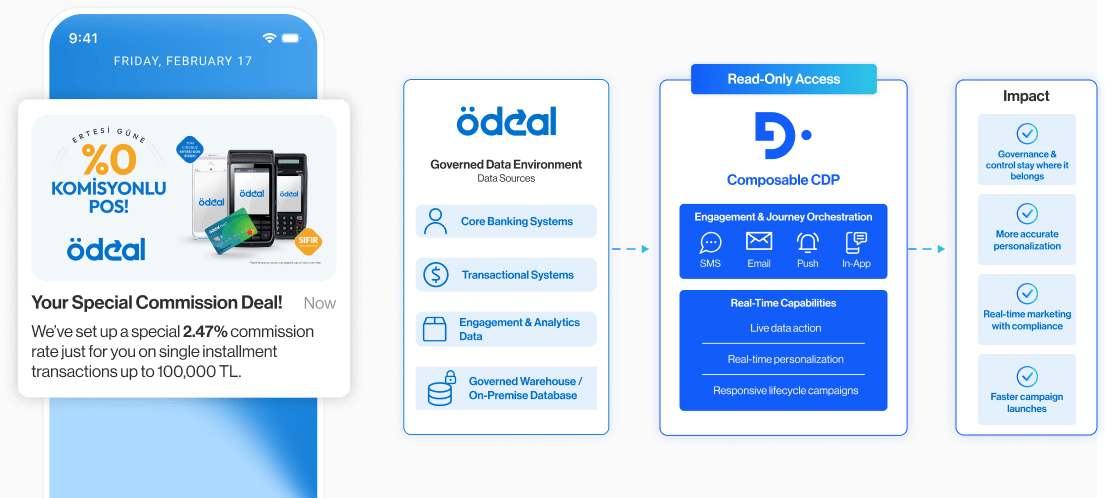
That was the challenge faced by Ödeal, one of Türkiye’s leading PayTech companies serving micro businesses and SMEs. As the company scaled, it needed a way to unify customer engagement across channels while operating within a highly sensitive financial data environment.
Using D·engage’s on-premise customer engagement infrastructure alongside remote data activation capabilities, Ödeal was able to centralize customer communication, orchestrate personalized journeys, and build more responsive lifecycle campaigns without creating another duplicated customer data estate. Instead of forcing financial and transactional data into a separate marketing platform, D·engage could work directly with their existing infrastructure.
The operational impact goes beyond architecture. Campaigns launch faster because marketing teams are no longer dependent on lengthy integration projects. Personalization becomes more accurate because segmentation reflects live customer states rather than yesterday’s sync cycle.
And governance teams retain control because sensitive customer data remains inside the organization’s own environment.
For financial services organizations, that combination gives you the ability to run true real-time marketing while maintaining the compliance standards the industry demands.
Retail and e-commerce: reacting to live customer behavior in real time
Retail data is ever-changing with product views, purchases, loyalty activity, stock availability, browsing behavior, and campaign engagement fluctuating throughout the day. For enterprise retailers, much of that information lives inside cloud warehouses processing millions of rows of transactional and behavioral data in real time.
The challenge is making that data actionable quickly enough for marketing teams to respond.
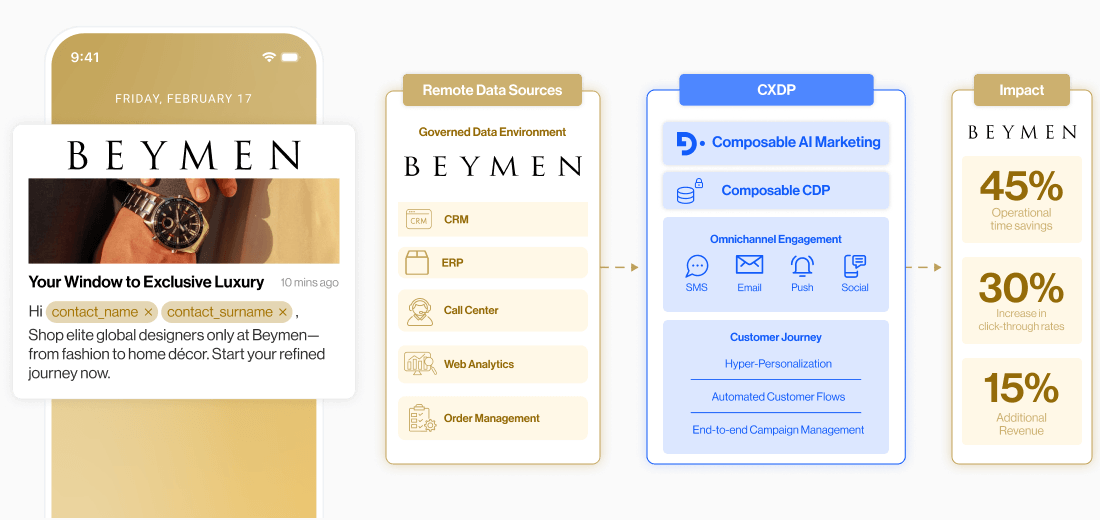
That’s exactly what luxury fashion retailer Beymen needed to solve. Operating across digital and physical retail environments, Beymen wanted to create more personalized customer journeys while reducing the operational friction caused by disconnected systems and fragmented data access.
Using D·engage’s remote source capabilities, Beymen was able to work directly with live customer and transactional data without duplicating massive datasets into another platform. Marketing teams could build more dynamic audience segments, react faster to customer behavior, and personalize campaigns using current purchase and engagement data instead of relying on outdated sync cycles.
The business impact was tangible. Beymen reported improved campaign agility, stronger cross-channel personalization, and a more unified customer experience across its digital touchpoints. The remote sourcing architecture also reduced the operational burden on technical teams because marketers could access and activate warehouse data without waiting for ongoing integration work or manual exports.
For retailers operating at enterprise scale, that speed matters commercially. Customer intent changes quickly, inventory changes quickly, and opportunities disappear quickly. Remote sourcing allows marketing teams to work directly against live commercial data, making personalization more responsive and campaigns significantly more relevant.
How remote sourcing fits the CDP model
The core idea behind a composable CDP is simple: the warehouse remains the source of truth, and the activation layer works directly against it rather than replacing it.
But that model only works if the platform can access warehouse data without copying it first. Otherwise, the same duplication problem still exists: the data is just being replicated from the warehouse instead of from the CRM.
That’s what remote sourcing changes.
It turns composable architecture from a positioning statement into a practical operating model. Remote tables extend D·engage’s star schema beyond the platform itself, allowing warehouse and database data to be queried relationally as part of a single customer view without being moved or stored separately.
For organizations running D·engage on-premise, the result is a fully self-contained architecture: the platform runs inside the client’s infrastructure, the data stays inside the client’s infrastructure, and marketers can still activate it in real time.
Build campaigns from live data, not stale copies
Remote sourcing changes the relationship between marketing platforms and enterprise data. Instead of creating another copy of customer information, D·engage allows organizations to work directly with the systems they already trust: activating live data for segmentation, personalization, and orchestration without disrupting the existing architecture.
For marketing teams, that means faster access to richer customer data and more accurate real-time engagement. For IT and compliance teams, it means maintaining control, reducing operational overhead, and avoiding the risks that come with unnecessary duplication.
As enterprise data environments continue to grow more complex, platforms that can work with that complexity — rather than forcing organizations to rebuild around them — will increasingly become the standard.
Request a personalized demo to see how D·engage’s remote sourcing architecture can help your team activate live customer data faster, more securely, and without duplication.
Moments We Help You Own
See how leading brands use our platform to enhance performance, improve customer experiences, and achieve measurable business outcomes.
Case Study
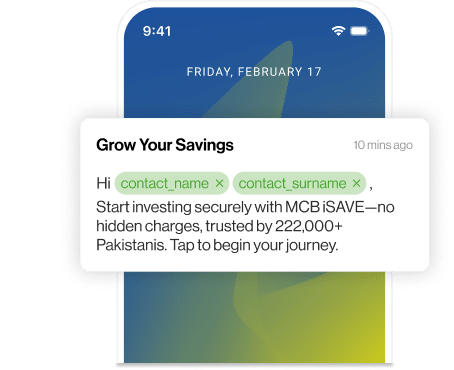
How MCB Funds achieved an 83% boost in account funding
“We boosted our efficiency with D•engage through automation, real-time data sync, and AI-driven targeting, achieving 83% higher account funding and 60% improved operations. All this in just the first year of its integration - This is truly phenomenal”
Monis Usman, EVP Head of Digital Business & Marketing- 83%improvement in account funding ratio
- 30%increase in average transaction size
- 60%improvement in operational efficiency

Case Study
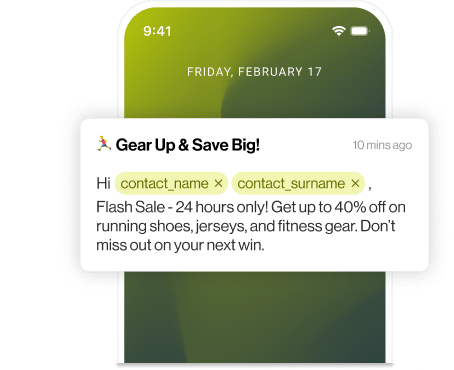
Sportive Increases Transaction Value by 38% with D·engage CRM Integration
“D·engage’s platform perfectly aligned with Sportive’s business needs. The platform demonstrated superior performance in integrating customer data, generating personalized content, and automation capabilities”
Anıl Can Öztürk, Digital Commerce Director- 38%increase in transaction value
- 17%increase in customer shopping frequency
- 21%increase in Google Ads ROAS

Case Study
Beymen drives 30% more clicks and 15% more revenue with D•engage
“Since we started working with D•engage, we’ve gained significant operational efficiency in segmentation, campaign management, and omnichannel communication. We can design personalized campaigns end-to-end through the panel and easily measure content performance with A/B testing.”
Gürhan Öztürk, Communication and Platform Manager- 30%increase in click-through rates
- 15%additional monthly revenue
- 15%time savings in operational processes


Case Study
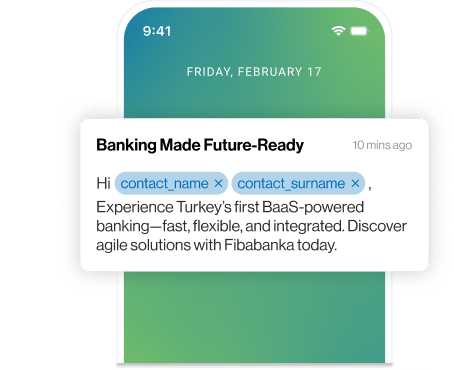
How Fibabanka Achieved 0% Downtime and 35% Cost Savings with D·engage
“Sending SMS and email messages without any disruptions is very important in banking processes. Any interruptions can affect our entire sales process. Therefore, the 24/7, high-availability of the platform we use is extremely critical for us.”
Korhan Kocabıyık, Platforms Development Director- 35%reduction in costs
- 18%reduction in time.
- 0%downtime with on-premise platform

Related Articles
Start Engaging Smarter
Bring all your data, channels, and customers together in one connected platform that works as fast as you do.