The ONLY marketing automation platform with a composable CDP
It's the monthly performance review. The email platform says campaigns drove 1,200 purchases. The ad platforms claim 1,450. The order database shows 900 orders in total, from every channel combined.
Nobody is lying. Each system counts what it can see, using its own rules. The email tool sees clicks. The ad platforms see their own pixels. The order database sees cash. None of them sees the customer.
That gap is what fragmented data looks like from the inside. And it points to an uncomfortable truth: most of your data isn't bad. It's copied. Every system keeps its own copy of the customer. Each copy updates on its own schedule, loses detail in its own way, and slowly drifts from the others.
This guide explains why copying is the hidden cause of fragmented data, what software can and can't fix, and a practical way to start without a year-long data project.
What is fragmented data?
Fragmented data is customer information split across systems that don’t share a common view of the customer. A shop’s till, its website, its app, its CRM and its ad platforms each hold part of the picture. Because no single system holds all of it, no team can reliably see, count or act on the whole customer.
In short
- Most fragmented data isn’t bad data. It’s copied data: the same customer held in many systems, each copy a little different and a little out of date.
- It’s the most common barrier marketers report. The average organization manages customer data across seven sources, and only about a quarter of marketers are satisfied with how connected it is.
- Buying another tool that makes another copy rarely fixes it. Most failed customer data projects also fail for organizational reasons, not technical ones.
- The better approach copies less: marketing tools read the data where it already lives. Then start small, with three tables, two or three use cases, and clear owners.
- Some problems stay human. No tool can repair a fake email typed at a till.
What the research says about fragmented data
Across every major survey of the last two years, marketers name disconnected data as their biggest practical barrier.
| What marketers report | Figure | Source |
|---|---|---|
| Customer data sources the average organisation manages | 7 | (Source) |
| Marketers satisfied with their data connectivity | 26% | (Source) |
| Marketers with full visibility into commerce data | 51% | (Source) |
| Marketers held back by data challenges | 81% | (Source) |
| Say disconnected platforms are a top data blocker | 54% | (Source) |
| Share of martech capability actually used | 49% | (Source) |
| Name data integration as their biggest stack challenge | 65.7% | (Source) |
| CDP owners whose CDP meets all current needs | 10% | (Source) |
| Marketers whose top challenge is manual data wrangling | 40% | (Source) |
Three patterns stand out.
Marketers don’t lack data. They lack connected data. Salesforce found that over half of marketers have real-time data available, but need technical help to use it. The data exists. It just can’t reach the person building the campaign.
The disappointment is with tools, not with the goal. In the Forrester study, 45% of CDP owners said their platform had underperformed against business expectations. Yet two-thirds still called CDP adoption a strategic priority.
Most failures are organizational. The CDP Institute found that companies with deployed CDPs cite organizational problems four times more often than technology failures. Any honest answer to fragmented data has to cover people and process, not just architecture.
The human cost: three roles, three versions of the same problem
Fragmented data feels different depending on where you sit. Most content on the topic speaks to only one of these people. Fixing it needs all three.
The channel specialist: numb to the friction
Picture a paid media buyer or a CRM manager. They rarely say “data architecture”. They say “the numbers never match”.
The ad platform reports more purchases than the order database. The CRM can’t see who bought in-store. So every week brings the same ritual: export three CSV files, join them in a spreadsheet, upload a suppression list, and hope nothing changed in between.
Most specialists don’t call this fragmented data. They call it Friday afternoon. In Adverity’s research, 40% of marketers named manual data wrangling for reporting as their top challenge. What they want isn’t another architecture diagram. They want the spreadsheet ritual to stop.
The marketing leader: wary of the next "fix"
Directors, VPs and CMOs feel fragmented data as a credibility problem. They defend numbers that don’t match finance’s, and explain why acquisition costs rise while retention slips.
Yet when a vendor promises a “single source of truth”, many leaders feel dread, not relief. They have seen big data projects run long, absorb engineering time and end as an expensive newsletter tool. The research backs that caution: in one Forrester study, 45% of CDP owners said their platform underperformed against business expectations.
Leaders resist new tools not because they think their data is clean. They resist because they know it isn’t, and they know a big migration will expose it.
The data team: guarding the warehouse
Behind marketing sits a data or BI team. Over the last few years they have built a central home for company data, often in a cloud warehouse such as Snowflake, BigQuery, Redshift or Databricks, or in an on-premise database.
Every new marketing tool tends to land on their desk. Someone has to build the connector, reshape the data to fit the tool, and fix the sync when it breaks. So data teams often see marketing tools as maintenance work and security risks, not as progress.
What all three have in common
Each person is reacting reasonably to the same root cause. Customer data is copied into many places, and each copy drifts from the truth. The rest of this guide is about that root cause.
Why fragmented data happens: it's copied, not bad
For a decade, the standard answer to fragmented data was to buy a packaged customer data platform. The idea was simple: copy all customer data into the platform, then market from there.
That approach works for some companies. But copying data creates four problems of its own, and they explain why so many projects disappoint.
1. Copying: you pay to store the same data twice
Most companies already hold their transactions, returns, loyalty tiers and service history in a central database or warehouse. A copy-based platform asks you to build pipelines that move that data into its own storage.
Now the same customer lives in two places. You maintain the pipelines between them. And many platforms price by profiles, events or data volume, so more data means a bigger bill. In high-volume markets such as retail, telecoms and banking, that cost grows fast.
2. Flattening: you lose the detail that makes data useful
Real business data is relational. That means it’s stored as linked tables, not one big list:
- A customer has many orders.
- Each order has many line items.
- Each line item points to a product, which links to stock levels, categories and margin.
Many marketing platforms can’t read linked tables directly. So the data team squeezes everything into one flat row per customer, such as “last category bought: footwear, lifetime spend: 450”.
That flattening throws detail away. You can no longer easily target by return status, store stock or a specific product’s margin. Every new idea for a segment becomes a request to the data team to build another summary field. Learn more in our guide to star schema and relational tables.
3. Delay: campaigns act on yesterday's customer
Copies are updated on a schedule, often hourly or nightly. Between updates, the marketing platform works from a stale picture.
Here’s what that looks like in practice:
- 2:00 pm. A customer buys a winter coat in-store and gives their mobile number at the till.
- 2:05 pm. The sale lands in the store system.
- 4:30 pm. The customer gets an email offering 15% off the coat they already bought.
- Why? The store data waits for the overnight sync before the marketing platform sees it.
The brand gives away margin, keeps paying to advertise to an existing customer, and looks careless.
4. Drift: the copy slowly stops matching the original
The central warehouse keeps changing. Teams add columns, rename events and retire old fields. Unless someone updates every pipeline each time, the marketing copy slowly falls out of step.
Drift is quiet. Nothing breaks on day one. Months later, a segment returns the wrong people, or a trigger stops firing, and nobody can say exactly when it started.
What software can fix, and what it can't
The martech industry has hurt its own credibility by promising that software alone cures fragmented data. It doesn’t. Being clear about the limits is the first step to a plan that works.
What no platform can fix
- Bad data at the point of capture. If a cashier types 0000000000 or noemail@noemail.com to skip a checkout field, no algorithm can recover the real customer.
- Records merged by mistake. If an old system migration combined two people into one account, software can’t reliably tell whose purchases were whose.
- Missing links. If no shared identifier exists between two systems, no phone number, email or loyalty ID, a tool can’t invent one.
- Unclear ownership. If nobody owns customer data quality, it decays, whatever platform sits on top. This is the organizational failure the CDP Institute keeps finding.
So most of your data isn’t bad. It’s copied, and the copies have drifted apart. But some of it is genuinely bad, and only people and process can fix that part.
Why this matters even more for AI
Many teams are now adding AI to marketing. AI can’t predict churn if it can’t see in-store purchases or open support tickets. It can’t recommend the right product if it can’t see stock or price.
Salesforce found that 61% of marketers say AI isn’t fully embedded in their marketing systems. Put AI on top of fragmented data and you mostly get faster, more confident irrelevance. We cover this in more depth in the marketing AI adoption and ROI gap.
What architecture can fix
What software can remove is the fragility that copying creates: duplicate storage, flattened detail, sync delays and drift. That’s the focus of the next section.
The fix: bring marketing to the data, not data to marketing
If copying causes fragility, the answer is to copy less. Instead of moving customer data into a marketing platform, the platform reads the data where it already lives. This is the idea behind a composable CDP: a customer data platform built on top of your existing data, rather than as a separate store. Analysts expect this to become the norm. Gartner predicts that by 2030, 80% of new enterprise CDP deployments will be embedded in or composable with data platforms, rather than stand-alone.
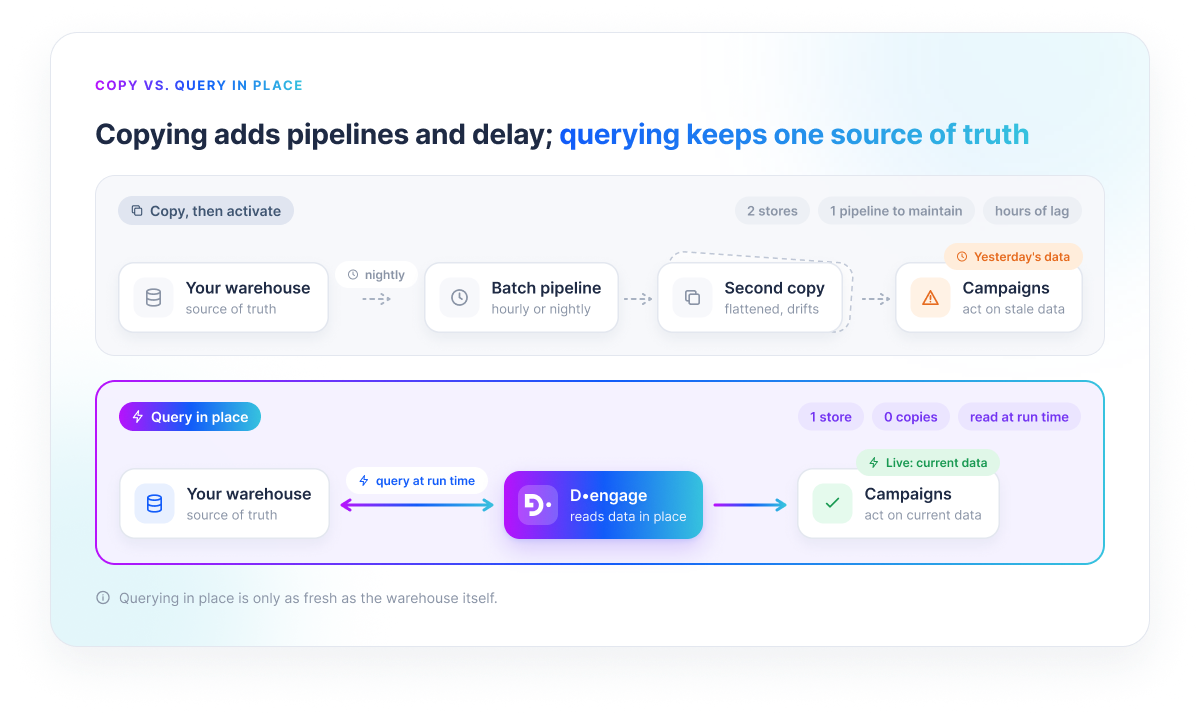
The copy path adds a pipeline and a second store that can lag and drift. The query path keeps one store and reads it when the campaign runs.
Here's how D•engage puts that idea to work.
1. Remote Data Sourcing: query the data, don't copy it
With Remote Data Sourcing, D•engage connects directly to the systems that already hold your customer data. That includes cloud warehouses such as BigQuery and Redshift, and relational databases such as SQL Server, whether in the cloud or on-premise.
When a campaign or segment runs, D•engage asks the source a question and uses the answer. The source stays the source of truth, with its own security and access rules intact.
In practice, that means:
- No duplicate customer store to pay for or keep in sync.
- No flattening. Segments can use linked tables directly: orders, line items, products, stores.
- New data is usable once it’s connected. When the data team adds a table or refines a score, marketing can use it without a new pipeline.
2. Matching customers across systems
Customer data rarely shares one universal ID. The till knows a mobile number. The website knows an email. The app knows a device token or loyalty ID.
Rather than forcing every record into a new master ID first, D•engage links customers using the identifiers your systems already share. If the loyalty table holds both the phone number and the email, it becomes the bridge between an in-store purchase and an online profile. You map how your tables connect once, instead of rebuilding your database.
3. Segment Canvas: every data source in view, filtered at every step
Segment Canvas is Dengage’s visual workspace for building segments. All your connected data sources sit together in one view: order history, customer attributes, engagement data and warehouse tables connected through Remote Data Sourcing. Marketers drag in the data they need and filter it at any step. You can filter three sources, combine them, filter the result again, then drag that in and combine it with something else. Every source and every step stays visible, so you can always see exactly how the audience was built.
Say you want to reach VIP customers who bought outerwear in store in the last 45 days, haven’t opened an email in two weeks and have the app installed. Drag in in-store orders and filter to outerwear bought in the last 45 days. Drag in email engagement and filter to customers with no opens in two weeks. Combine the two, then combine the result with app users and filter to VIP loyalty status. Dengage turns the canvas into a query that runs against your connected data, so the audience reflects the data at the moment it runs.
4. Zeki AI: intelligence that sits on connected data
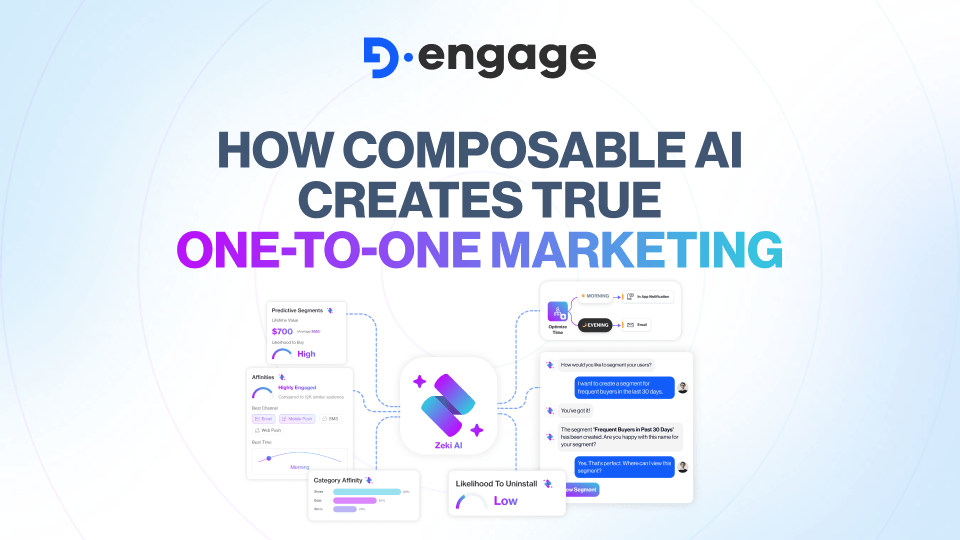
Once data is connected, AI has something solid to work with. D•engage’s Zeki AI works on the same connected data the rest of the platform uses. That supports:
- Predictive segmentation: spotting customers likely to buy, lapse or churn.
- Send-time and channel optimization: choosing when, and through which channel, each customer is most likely to respond.
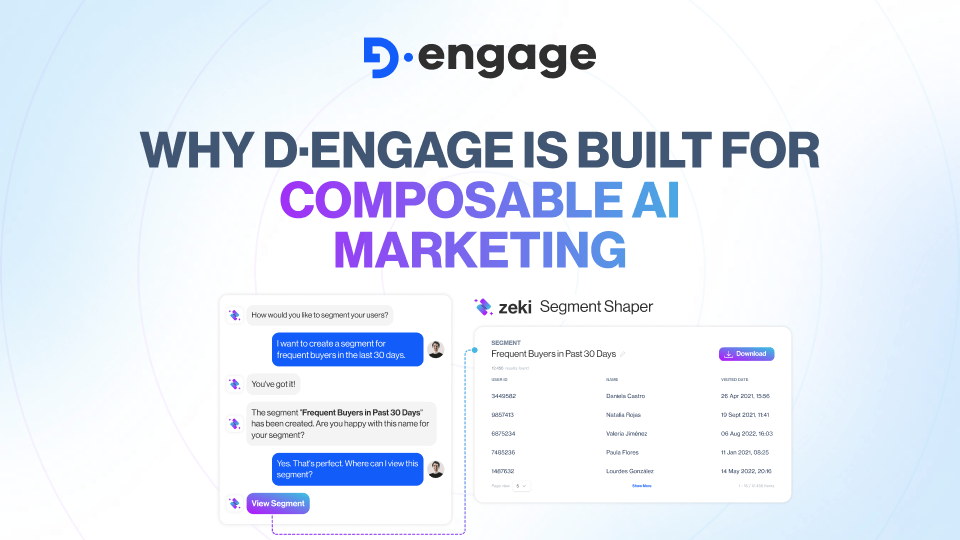
- Plain-language segmentation: describing an audience in words and getting a segment back.
The trade-offs, stated plainly
Querying data in place is not magic. Anyone evaluating this approach should know four things:
- It’s only as fresh as the source. If store sales reach your warehouse once a night, a live query still sees last night’s data. The winter coat problem is only solved if the source itself updates quickly, or if the till system is connected directly.
- Queries use computing power. Reading the warehouse at campaign time costs warehouse compute. You stop paying for a duplicate store, but you should budget for queries.
- The modelling work moves, it doesn’t vanish. Someone still decides how tables link and what each field means. That work now happens once, in your own environment, instead of inside a vendor’s tool.
- Some data is still better copied. Data that needs heavy reshaping before it’s useful can still justify an ingestion pipeline. D•engage supports both, and our guide to CDP ingestion vs remote sourcing explains when to use each.
The goal isn’t zero copies at any cost. It’s to stop copying by default, and copy only where it earns its keep.
A practical playbook: start with three tables, not the whole warehouse
The most common reason for delay is the belief that all historical data must be cleaned before anything launches. It’s a false barrier. You don’t need clean records from 2017 to recover an abandoned cart today.
The Rule of Three Tables
In our experience, most revenue-driving lifecycle campaigns draw on just three kinds of data:
- Recent transactions. What each customer bought in roughly the last 90 days, through which channel, and in which category.
- Contact identity and consent. Verified phone numbers and email addresses, with opt-in and privacy flags.
- Live digital behavior. Website and app activity such as product views, searches and cart changes.
Connect these three first. Marketing can start running targeted journeys while the data team improves everything else in the background. We call this incremental activation: value first, perfection over time.
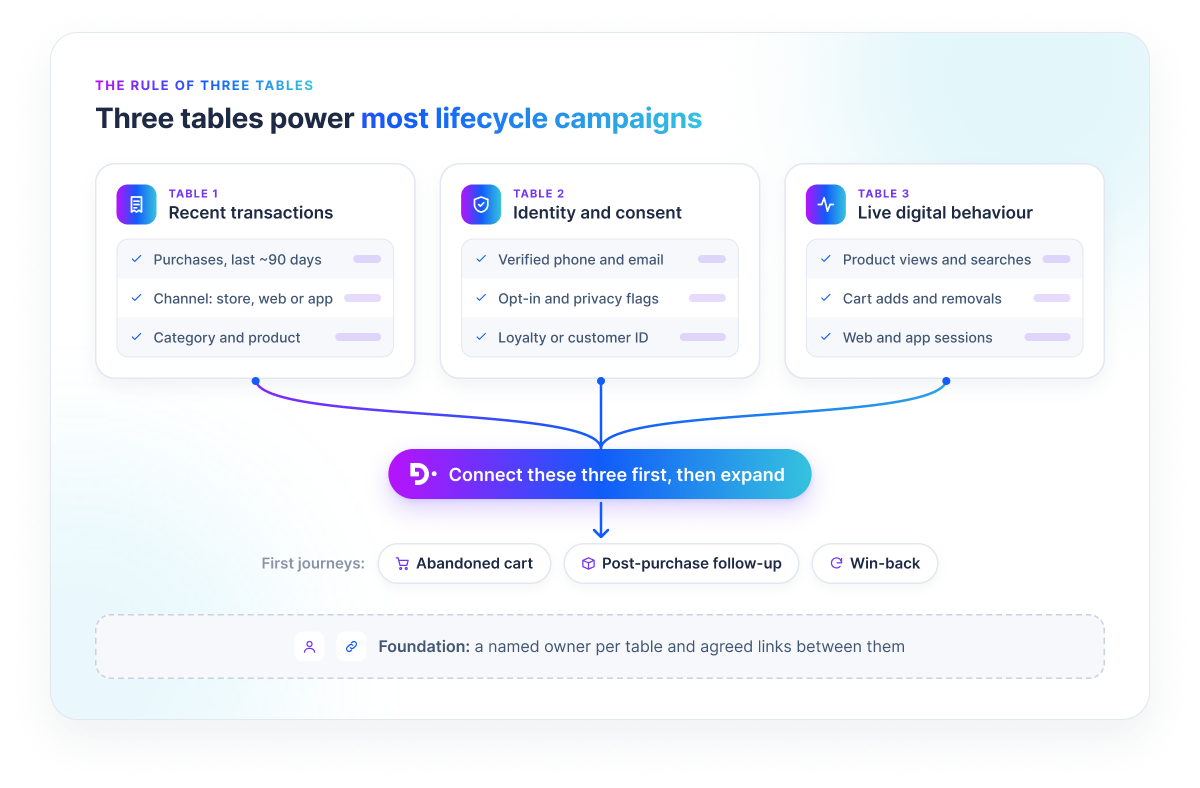
Ownership and agreed links underpin all three tables; without them, even connected data decays.
Seven steps to get started
- Map where customer identity lives. List every system that holds a phone number, email, loyalty ID or device ID, and which ones overlap.
- Pick two or three use cases. For each, write down the audience, the data it needs, the channel, the KPI and today’s baseline. Projects without defined use cases are a leading cause of failure.
- Name an owner for each of the three tables. One person accountable for its accuracy and freshness.
- Check how fresh each table really is. If a source only updates nightly, decide whether that’s good enough for the use case or needs fixing first.
- Connect the three tables and map how they link. Agree which identifiers join which tables.
- Launch the first journeys. Good starters: abandoned cart, post-purchase follow-up that stops acquisition offers, and win-back for lapsing customers.
- Measure against finance’s numbers, not platform numbers. Compare results with orders and revenue in your own systems. Then add the next data source.
Readiness checklist
- We know which systems hold each customer identifier.
- We have chosen two or three use cases with a KPI and baseline.
- Each of the three core tables has a named owner.
- We know how often each table updates.
- Consent and opt-in flags are stored with contact data.
- Marketing and the data team have agreed who builds what.
- We will judge success using our own order and revenue data.
Governance: where your customer data is allowed to live
For banks, insurers, telecoms and healthcare providers, fixing fragmented data is also a compliance question. Privacy laws such as GDPR in Europe, KVKK in Turkey and LGPD in Brazil, plus sector rules, can limit where personal data is stored and who processes it. A setup that copies everything into a vendor’s shared cloud may not pass review.
D•engage offers several deployment models, so the architecture can match the rules:
| Deployment model | Where customer data lives | Typical fit |
|---|---|---|
| Cloud (SaaS) | In D•engage's cloud | Fast-growing brands that want speed and no infrastructure to run |
| Composable, with Remote Data Sourcing | In your own warehouse or database; D•engage queries it | Teams with an established data warehouse |
| Private cloud | In a dedicated environment inside your own cloud | Enterprises with strict security policies |
| On-premise | On your own servers, inside your firewall | Regulated banks, telecoms and public sector |
See on-premise marketing automation explained for how the on-premise model works.
Data clean rooms and first-party data
A data clean room lets two companies, such as a retailer and a media partner, match audiences without either side seeing the other’s raw personal data.
The case for clean rooms is no longer about cookies disappearing. In April 2025, Google confirmed it would keep third-party cookies in Chrome and leave the choice to users. The case now rests on privacy law, browsers such as Safari and Firefox that already block third-party cookies, and the growth of retail media networks.
Whatever the driver, clean rooms need well-organized first-party data with reliable identifiers. If customer identities are scattered across five disconnected tools, matching with partners is close to impossible. Linking identities inside your own environment is the groundwork. Read more in data clean rooms explained.
How two brands tackled fragmented data
One is a fashion retailer, the other an asset manager. Their industries differ, but their starting points looked remarkably alike.
Nishat: unifying online and offline fashion retail
The business. Nishat is one of Pakistan’s leading premium fashion retailers, with a nationwide store network and a growing global e-commerce business.
The fragmentation. Customer data sat across the CRM, web analytics, mobile apps, POS systems and email tools. Records were partial, duplicated or out of date. Syncs ran hours or days behind. Segments were often static lists that depended on the data team, and each channel ran from a separate tool.
What they did.
- Connected the CRM, mobile app and website to D•engage’s composable CDP through APIs and SDKs, with customer data streaming in near real time.
- Mapped customer identifiers into unified profiles, then validated, cleaned and de-duplicated records.
- Built dynamic segments, including RFM analysis to find inactive and at-risk customers.
- Moved email, push and SMS into one platform and launched journeys such as cart abandonment, welcome series and reactivation.
- Trained marketing and developer teams so marketers could build segments and campaigns themselves.
The results. A 360-degree view of customers, 150% growth in engagement rates and a 2x increase in revenue (read the Nishat story).
“Their Composable CDP has successfully unified online and offline customer behaviors into true 360 degree customer profiles.” — Team Nishat
The lesson. Nishat combined connection with hygiene. The architecture brought the data together, and the cleaning and training made it usable.
MCB Funds: personalized journeys in financial services
The business. MCB Funds is one of Pakistan’s leading asset management companies, serving over 200,000 customers.
The fragmentation. MCB Funds needed to unify customer data and align it with its internal data warehouse. Messaging was largely one-size-fits-all, and automation lacked the event triggers needed for timely, personal journeys.
What they did.
- Used a customizable data schema to bring transaction histories, behavior and engagement data together for targeting.
- Used Remote Source to segment on data that stays in its original systems.
- Applied RFM modelling and AI-driven segmentation to send tailored investment recommendations.
- Ran push, in-app and email journeys to guide new customers through account funding, plus win-back campaigns.
The results. In the first year: an 83% improvement in the account funding ratio for new accounts, a 30% increase in average transaction size, and a 60% improvement in operational efficiency (read the MCB Funds story).
“With the Remote Source feature, we can integrate various data sources without needing the data to reside within the platform, and use this data to create complex segments.” — Monis Usman, EVP Head of Digital Business & Marketing, MCB Funds
What both stories show
- The data existed. Both brands already held what they needed. It was spread across systems that didn’t talk.
- Both started with specific journeys. Funding, reactivation and cart recovery came before any attempt to perfect the whole data estate.
- Both put marketers in control. Results followed when marketing could build segments and journeys without waiting on engineering.
Frequently asked questions about fragmented data
What is fragmented data?
Fragmented data is customer information spread across systems that don’t share a common view of the customer, such as a POS, an e-commerce platform, an app, a CRM and ad platforms. Each system holds part of the picture, so no team can see, count or act on the whole customer.
What causes fragmented data?
It builds up as companies add tools. Each new system collects its own data with its own identifiers. Copying data between systems through scheduled pipelines adds more problems: delays, flattened detail, and copies that drift from the original over time.
How does fragmented data affect marketing?
It causes mismatched reports, wasted ad spend on existing customers, offers sent after a purchase, slow segment building, and heavy manual spreadsheet work. It also limits AI, because predictions and recommendations are only as good as the data the model can see.
Can a CDP fix fragmented data?
A CDP can help, but it’s not a cure on its own. Research from the CDP Institute shows most CDP projects that struggle do so for organizational reasons, such as unclear ownership and goals. A CDP works best with defined use cases, named data owners and an architecture that doesn’t depend on fragile copies.
What is a composable CDP?
A composable CDP works on top of the data a company already holds, usually in a cloud warehouse or relational database, instead of keeping its own separate copy. It adds segmentation, identity matching and activation without moving the data elsewhere.
What is remote data sourcing?
Remote data sourcing means a marketing platform queries customer data in its original system when a segment or campaign runs, instead of importing a copy. The source system stays the single source of truth, with its own security and access controls.
Do I need to clean all my data before fixing fragmentation?
No. Start with the data your first use cases need, typically recent transactions, contact details with consent, and live web and app behavior. Improve older and less-used data over time. Waiting for perfect data is one of the most common reasons projects stall.
Is zero-copy always better than copying data?
Not always. Querying data in place avoids duplicate storage and sync delays, but it’s only as fresh as the source and uses warehouse computing power. Data that needs heavy reshaping can still be worth copying. Most enterprises benefit from a mix, with querying in place as the default.
Stop boiling the ocean
Fragmented data isn’t a reason to accept broken spreadsheets, and it isn’t a reason to spend a year cleaning everything before you act.
Some of your data is genuinely bad, and only people and process will fix that. But most of it isn’t bad at all. It’s copied, again and again, into systems that drift apart. That part has an architectural answer: leave the data where it lives, stop copying by default, and give marketers direct, governed access to it.
Start with three tables, two or three journeys and clear owners. Then build from there.
D•engage is a G2 Momentum Leader in 8 categories. See how Remote Data Sourcing and Segment Canvas work on your own data: book a demo.
Moments We Help You Own
See how leading brands use our platform to enhance performance, improve customer experiences, and achieve measurable business outcomes.
Case Study
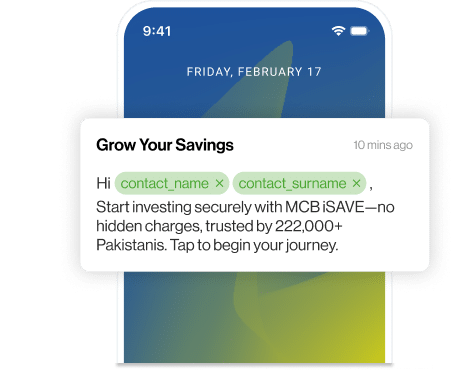
How MCB Funds achieved an 83% boost in account funding
“We boosted our efficiency with D•engage through automation, real-time data sync, and AI-driven targeting, achieving 83% higher account funding and 60% improved operations. All this in just the first year of its integration - This is truly phenomenal”
Monis Usman, EVP Head of Digital Business & Marketing- 83%improvement in account funding ratio
- 30%increase in average transaction size
- 60%improvement in operational efficiency

Case Study
Sportive Increases Transaction Value by 38% with D·engage CRM Integration
“D·engage’s platform perfectly aligned with Sportive’s business needs. The platform demonstrated superior performance in integrating customer data, generating personalized content, and automation capabilities”
Anıl Can Öztürk, Digital Commerce Director- 38%increase in transaction value
- 17%increase in customer shopping frequency
- 21%increase in Google Ads ROAS

Case Study
Beymen drives 30% more clicks and 15% more revenue with D•engage
“Since we started working with D•engage, we’ve gained significant operational efficiency in segmentation, campaign management, and omnichannel communication. We can design personalized campaigns end-to-end through the panel and easily measure content performance with A/B testing.”
Gürhan Öztürk, Communication and Platform Manager- 30%increase in click-through rates
- 15%additional monthly revenue
- 15%time savings in operational processes


Case Study
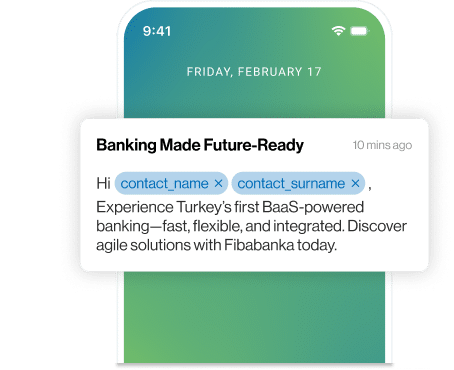
How Fibabanka Achieved 0% Downtime and 35% Cost Savings with D·engage
“Sending SMS and email messages without any disruptions is very important in banking processes. Any interruptions can affect our entire sales process. Therefore, the 24/7, high-availability of the platform we use is extremely critical for us.”
Korhan Kocabıyık, Platforms Development Director- 35%reduction in costs
- 18%reduction in time.
- 0%downtime with on-premise platform

Related Articles
Start Engaging Smarter
Bring all your data, channels, and customers together in one connected platform that works as fast as you do.