The ONLY marketing automation platform with a composable CDP
If your business has automated customer journeys, it's easy to assume you're already using AI. After all, your marketing reacts to customer behavior, sends personalized messages, and runs without anyone pressing send.
But automation and AI orchestration are not the same thing.
While traditional automation follows rules that marketers define in advance, AI orchestration continuously evaluates customer behavior and decides the next best action in real time.
It might sound like a subtle difference, but it's an important one. As AI reshapes marketing, organizations that can make decisions in the moment will outperform those still relying on static, rule-based journeys.
In this article, we'll explain where automation ends, where AI orchestration begins, and why understanding the difference could shape the future of your customer engagement.
Marketing automation follows instructions, and AI orchestration makes decisions.
At a quick glance, marketing automation and AI orchestration look similar. Both deliver personalized customer experiences, automate campaigns, and respond to customer behavior without constant human intervention.
From the outside, the difference isn’t always obvious because the distinction lies in how those customer experiences are created.
Traditional marketing automation is built around rules. Marketers define the triggers, conditions, and actions that make up a customer journey, then the platform executes those instructions exactly as designed.
For example “if a customer abandons their cart, wait four hours and send an email”. “If they don’t open it, send an SMS two days later”. Every customer entering that journey follows the same underlying logic because every decision has already been made.
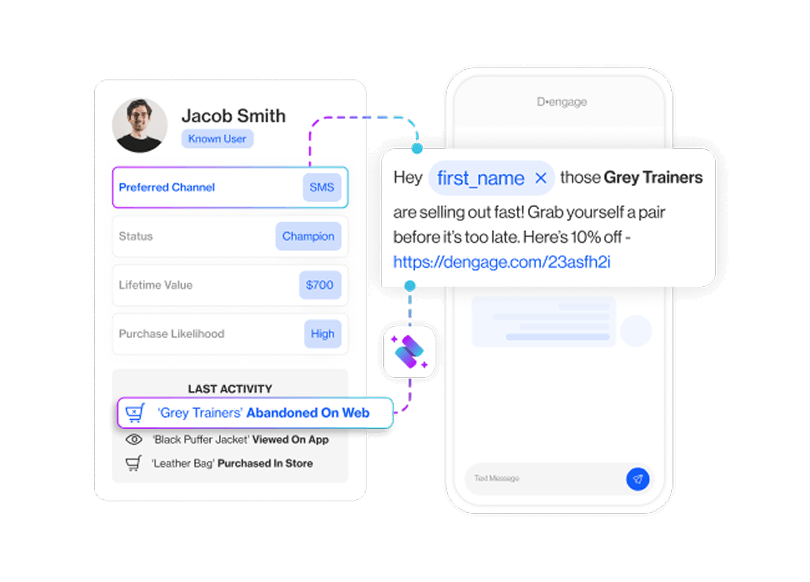
AI orchestration introduces a layer of intelligence above those predefined workflows. Rather than just asking, “What should happen next?” it asks, “What is the best thing to do for this exact customer right now?”
This means one customer might receive an email immediately, but another might receive a push notification later that evening. A third might receive no message at all because all signs point to them converting without additional encouragement.
This fundamental difference improves automation and moves marketing sequences from personalization to individualization.
When rule-based automation hits a ceiling
Of course, marketingt automation has come a long way from simple “if this, then that” workflows. Today’s platforms allow marketers to build sophisticated, branching customer journeys with multiple triggers, conditions, wait times, and channels working together.
The problem is that every possible scenario still has to be anticipated by a human.
As customer journeys become more complicated, so do the rules that govern them. A single lifecycle campaign might include different paths for first-time customers, repeat purchasers, loyalty members, subscribers, customers who opened but didn’t click, customers who clicked but didn’t convert, or customers who bought from one product category but ignored another.
Each new requirement means another rule, another branch, another exception. At first, that feels manageable. But over time, it becomes more and more difficult to maintain as journeys grow larger and overlapping rules become harder to spot.
When this happens, marketers spend more time updating workflow logic than improving the customer experience itself. Even relatively small changes can require multiple journeys to be reviewed and rewritten, simply to ensure they still behave as intended.
And, because rule-based automation can only respond to situations that a marketer predicted, it can’t adapt if a customer behaves in an unexpected way, or new information becomes available.
AI orchestration is different because it evaluates each customer’s situation as it unfolds, rather than relying on an ever-growing library of rules.
Marketing Automation vs. AI Orchestration: the 5 Decisions that Matter
Every customer journey depends on hundreds of small decisions. Traditional marketing automation relies on rules defined in advance, while AI orchestration makes those decisions dynamically as customer behavior changes.
The comparison below shows how that changes the way marketers engage customers.
| Decision | Traditional Marketing Automation | AI Orchestration |
|---|---|---|
| Who should receive the message? | Sends to everyone who meets predefined rules or segment criteria. | Selects the customers most likely to engage or convert based on real-time behavior and predictive insights. |
| When should it be sent? | Sends after a fixed delay or scheduled time. | Predicts the perfect moment for each individual based on engagement patterns and context. |
| What should they see? | Delivers content or offers based on predefined rules or audience segments. | Chooses the message, offer, or recommendation most likely to resonate based on customer behavior and intent. |
| Which channel should be used? | Uses a predetermined channel or fixed channel sequence. | Chooses the channel each customer is most likely to engage with (whether email, SMS, push, or in-app messaging). |
| Should a message be sent at all? | Assumes every qualifying customer should receive the next message in the journey. | Determines whether communicating adds value, suppressing messages that could reduce engagement, erode margin, or create fatigue. |
AI Orchestration Changes What Marketers Spend Their Time Doing
Traditional marketing automation asks teams to think through every possible customer scenario before a campaign goes live. This takes a lot of time, especially as customer journeys become more sophisticated.
Marketers spend more time building rules, testing edge cases, updating workflows, and maintaining increasingly complex logic. When AI takes on that administrative workload, marketers can spend more time defining the outcome they want to achieve.
They establish the goals, the guardrails, and the business priorities, while AI continuously determines the best way to deliver those outcomes for each customer. That’s why AI orchestration doesn’t make marketers less important. If anything, it makes strategic thinking even more valuable.
AI can’t decide what your brand stands for. It can’t determine your commercial priorities, understand your customers as deeply as your team does, or decide where to draw the line between personalization and privacy. Those remain human decisions.
What AI excels at is processing thousands of signals, weighing countless variables, and making operational decisions at a scale no marketing team could ever achieve manually.
In other words, AI orchestration amplifies the marketer’s expertise by taking care of the operational complexity that has traditionally eaten up so much of their time.
How D·engage Enables AI-Powered Marketing Orchestration
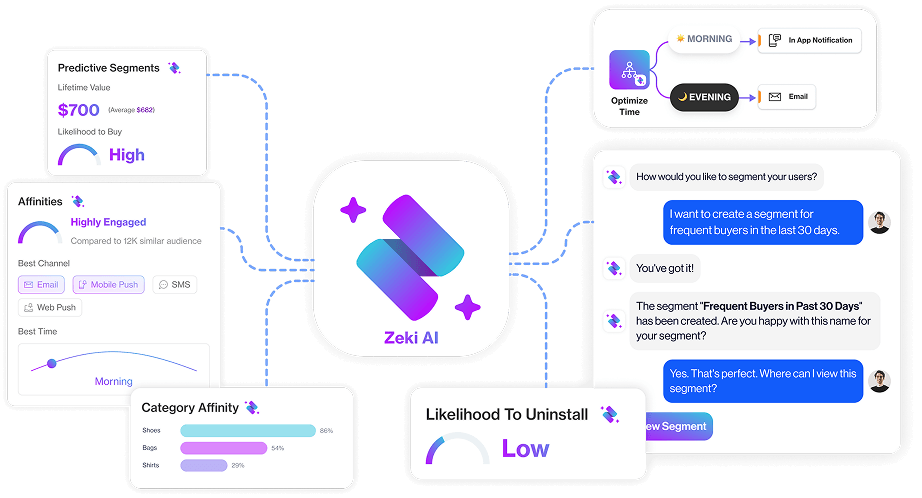
With D·engage, you can move beyond static customer journeys and start orchestrating experiences that adapt to every customer in real time. The CDP combines the data, intelligence and activation layers required for good AI orchestration together, in one platform.
Customer data connects directly with D·engage’s native cross-channel marketing automation and AI capabilities, so those decisions can immediately shape experiences across email, SMS, push, web, and other channels.
This connected approach is important because AI orchestration is only as intelligent as the customer context it can access, and only as useful as its ability to turn those decisions into action.
Ready to see what AI-powered orchestration looks like in practice? Book a demo of D·engage to discover how unified customer data, AI-powered decisioning, and cross-channel activation can help you build smarter customer journeys.
Moments We Help You Own
See how leading brands use our platform to enhance performance, improve customer experiences, and achieve measurable business outcomes.
Case Study
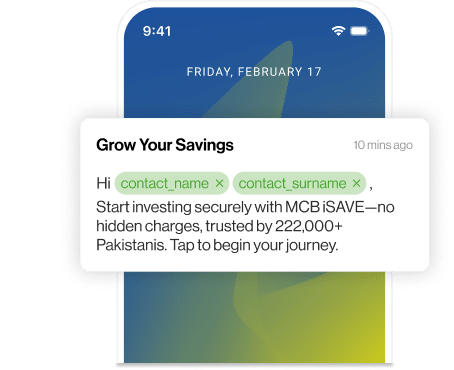
How MCB Funds achieved an 83% boost in account funding
“We boosted our efficiency with D•engage through automation, real-time data sync, and AI-driven targeting, achieving 83% higher account funding and 60% improved operations. All this in just the first year of its integration - This is truly phenomenal”
Monis Usman, EVP Head of Digital Business & Marketing- 83%improvement in account funding ratio
- 30%increase in average transaction size
- 60%improvement in operational efficiency

Case Study
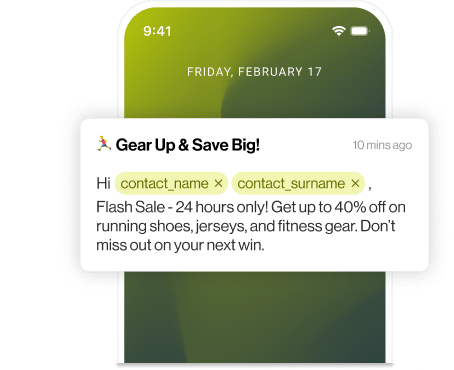
Sportive Increases Transaction Value by 38% with D·engage CRM Integration
“D·engage’s platform perfectly aligned with Sportive’s business needs. The platform demonstrated superior performance in integrating customer data, generating personalized content, and automation capabilities”
Anıl Can Öztürk, Digital Commerce Director- 38%increase in transaction value
- 17%increase in customer shopping frequency
- 21%increase in Google Ads ROAS

Case Study
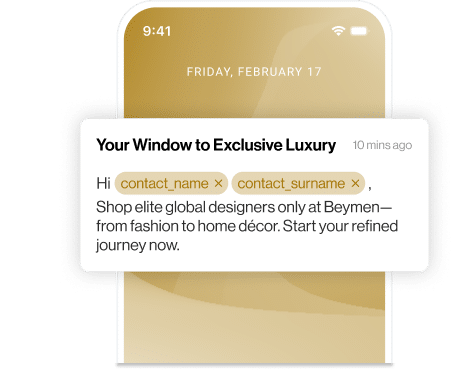
Beymen drives 30% more clicks and 15% more revenue with D•engage
“Since we started working with D•engage, we’ve gained significant operational efficiency in segmentation, campaign management, and omnichannel communication. We can design personalized campaigns end-to-end through the panel and easily measure content performance with A/B testing.”
Gürhan Öztürk, Communication and Platform Manager- 30%increase in click-through rates
- 15%additional monthly revenue
- 15%time savings in operational processes

Case Study
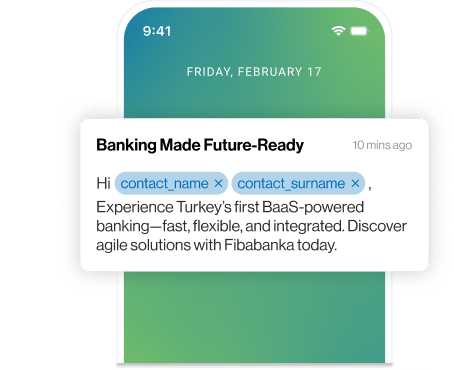
How Fibabanka Achieved 0% Downtime and 35% Cost Savings with D·engage
“Sending SMS and email messages without any disruptions is very important in banking processes. Any interruptions can affect our entire sales process. Therefore, the 24/7, high-availability of the platform we use is extremely critical for us.”
Korhan Kocabıyık, Platforms Development Director- 35%reduction in costs
- 18%reduction in time.
- 0%downtime with on-premise platform

Related Articles
Start Engaging Smarter
Bring all your data, channels, and customers together in one connected platform that works as fast as you do.